
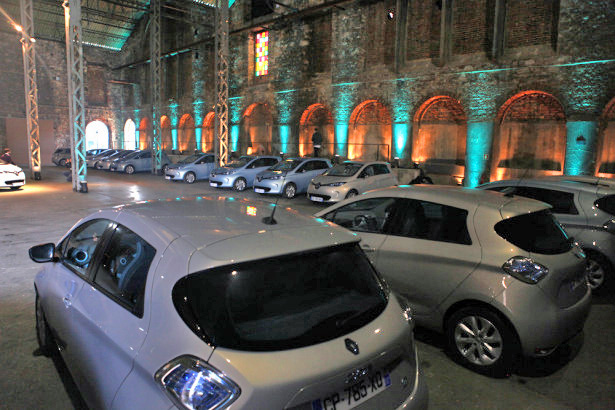
There, I’ve said it: The Renault ZOE will be a great success. It’s public, so we can come back next year and argue about whether I was right or not!
First of all I should probably qualify what I mean by ‘a great success’. I’d love to say that it will sell in huge numbers and revolutionise personal transport as we know it. While I think that’s a possible outcome, I don’t think it’s a likely one. The reasons are not technical – the ZOE is a fantastic design and engineering achievement – it is cultural. Most people are just not ready to drive an electric vehicle – certainly not in the UK, and probably not in most of Europe. I see a lot of hostility even to the idea of EVs in the British media so I know we have a long way to go in that respect.
Instead of ‘cultural’ above I nearly wrote ‘political’ but actually, in this instance, I don’t think it’s fair to criticise politicians – in both France and the UK they are generally significantly ahead of the population in preparedness for a change to electric transportation. It’s worth pointing out that the UK has particularly strong cross-party political support for EVs, something that isn’t true in the otherwise politically similar US, for example. Here we have a £5000 subsidy at point of sale on the car, plus a 75% subsidy on a home charge point; these are both very generous. Plus beyond that there’s free car tax, and exemption from congestion charges.
So anyway what I mean by ‘a great success’ is that it will achieve at least the same status and similar levels of sales to those in the club of leading electric vehicles in the world: the Nissan LEAF, the Chevrolet Volt (alias Vauxhall/Opel Ampera) and the Tesla Model S. I include the LEAF and Volt as they are leaders and pioneers in the field and have sold significant numbers around the world (60,000+ and 40,000+ respectively). I include the Tesla as its relatively low sales numbers (10,000+) are made up for by astonishing aesthetics and technical design, and its future sales potential. I exclude the Mitsubishi i-MiEV as its relatively healthy sales (20,000+) do not make up for its often poor performance when reviewed against the other vehicles, and its apparent current dramatic sales decline.

I expect to see significant monthly sales of the ZOE across Europe, though particularly in France and the UK, and I expect to see the sales numbers increase over time. The reasons are simple: it’s a fantastic electric car, it’s cheaper to buy than an equivalent internal combustion engine (ICE) car, and it’s cheaper to run and maintain than an equivalent ICE car.
However, not everyone agrees. According to InsideEVs.com this week ‘Falling Renault Zoe Sales in France Could Indicate Zoe is Suffering From Twizy Syndrome’:
“Although we would have liked to see more growth, it seems that Zoe may be suffering from ‘Twizy syndrome,’ which we define as high initial sales in the first few months of availability, followed by declining sales in the months that follow.”
Similarly MotorNature.com says ‘Much disappointing sales for the electric Renault Zoe in France’:
“It looks like the Zoe in France stands where the Nissan Leaf was in the U.S. in early 2012. Once all the early adopters got their car, demand just slowed. What nobody expected for the Zoe was that demand would slow only a few weeks after the car’s launch.”
The argument seems to be that low sales in France during May indicate that everyone in France who wanted to buy one has now done so, and demand has permanently dropped. I think this is wrong on three counts:
- I believe sales are supply limited. The ZOE is officially launched in the UK and Germany early this month. This means that during May Renault had to deliver, as a minimum, a large quantity of demonstrator and test drive ZOEs to these two countries – as well as ideally a quantity of examples that can actually be sold. These have to come out of the May production supply. Since the ZOE is built on a shared production line with the Clio – and that’s selling pretty well – there is a limit on the total number that can be built in a month. Therefore there must have been fewer available to sell in France during May.
- EV sales are notoriously intermittent, they come in fits and starts. It took time for sales of both the LEAF and Volt to take off and they did so to a large extent through word of mouth. They have unusually high scores for consumer satisfaction, and very often new customers come to them from meeting and talking with current customers. The same will happen with the ZOE – and certainly initial indications from the French ZOE forum are that current customers are extremely pleased with their ZOEs.
- Renault are doing very little to promote the ZOE. In fact, it is the poor relation in the Renault family. Its French launch was put back in preference to the Clio launch, so that it wouldn’t distract attention from the Clio. In the UK its launch this month coincided with the launch of the Captur. The Captur had a big launch event yesterday, with the TV wildlife presenter Steve Backshall fronting it at the Westfield shopping centre. The ZOE? Nothing. Real meaningful sales numbers will only kick in once Renault begins to promote the ZOE seriously – I trust that it will do so at some point (but see below).
The ZOE is a great car – arguably the only real competitor to the LEAF for most people in the market for an all-electric – but with better looks, range and charge technology. I expect increasing total sales across Europe, strong and steady growth, but with sales in any particular country being variable with economic and other fluctuations. Overall I would like to see by the end of the year sales of 3000-5000 vehicles per month, significantly higher than the LEAF has achieved so far.
So, returning to the bigger question, could the ZOE usher in a new and radical shift in electric transportation across Europe? Could it be the new iPhone (or BBC Micro, to those of my generation!) breaking down old barriers and entirely changing – or arguably creating – a marketplace? I would love that to happen, and I believe it still could happen. As touched on above, compared to a fossil car it’s cheaper to buy and run, looks good and provides a better driving experience (quieter, smoother, non-polluting, no smell, no unnecessary trips to refuel). So it should succeed. All it lacks is range – is that such a deal-breaker? Well, from online articles and comments it seems that is the sine qua non, that everything else counts for naught if it can’t go 300 miles without a break. However, it may only take another petrol price hike for that attitude to change.
What I think is actually the biggest barrier to the success of the ZOE is not the usual suspects. I think it’s Renault: if ZOE succeeds it will be despite, not because of, Renault. It is in a similar situation to its partner Nissan with the LEAF – its primary business is combustion vehicles and within that market it’s probably fair to say that Renault’s greatest strength is its engines, as demonstrated by its engine dominance in Formula One racing. It is almost certainly the case that Renault makes more money from a conventional car than an electric one, and a sale of a ZOE must often cost it a sale of a Clio. The push for EVs is coming from the top – from Carlos Ghosn alone, perhaps – and doesn’t seem to be reflected across the company. Many of those trying to purchase a ZOE have reported a common experience of poor communication, support and enthusiasm in dealings with Renault dealers and other representatives, in France and the UK.
Renault dealers are in the front line – every sale of a ZOE likely costs them a higher margin sale of a Clio. Worse, however, is that dealers often have very low sales margins anyway that are compensated for, in part, by the servicing income they get for each vehicle they sell. If the ZOE turns out to have as low maintenance requirements as has been demonstrated for the LEAF and Volt then they have the double whammy of little income at point of sale and low recurring income afterwards. Where then is the incentive for a Renault dealer to make the effort to sell the ZOE, especially as it likely requires additional investment in training, charge points, diagnostic equipment, and so on?
It could be argued that Tesla is going from strength to strength precisely because it doesn’t have this problem – it only makes EVs. Also, it’s interesting to note that at the inception of its EV program BMW realised there would be tension with its existing combustion business. It didn’t come up with a sophisticated solution – instead it created a whole new business. According to the Guardian, Uwe Dreher, the head of marketing for their electric car, said this was necessary in case traditional engineers unintentionally sabotaged the project:
“So we had to create a new platform. We got the power from the board and they told us to come to them if we were having problems, if people in the business wanted to kill it. It has been sitting aside as a separate structure in the company to protect it.”
It may take an approach as radical as this – for Renault ZE to be split off as a separate, independent business – for the ZOE to be the great success it has the potential to be.



Home › Forums › The Renault ZOE Will Be a Great Success!
This topic contains 13 replies, has 7 voices, and was last updated by Trevor Larkum 12 years, 3 months ago.
You must be logged in to reply to this topic.