Renault ZOE Electrifies the Flins Production Plant

Flins Production Plant (Image: Renault)

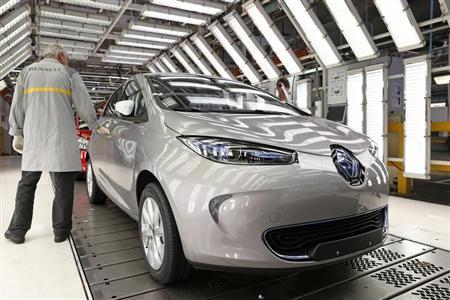
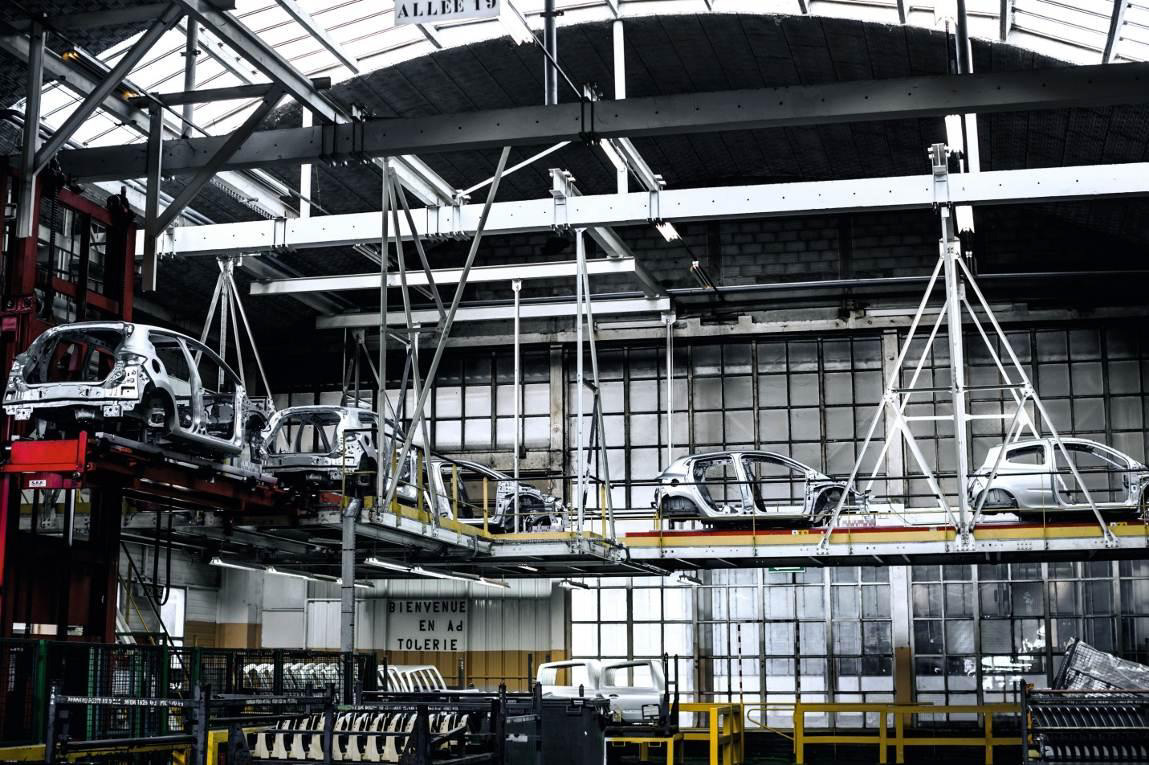
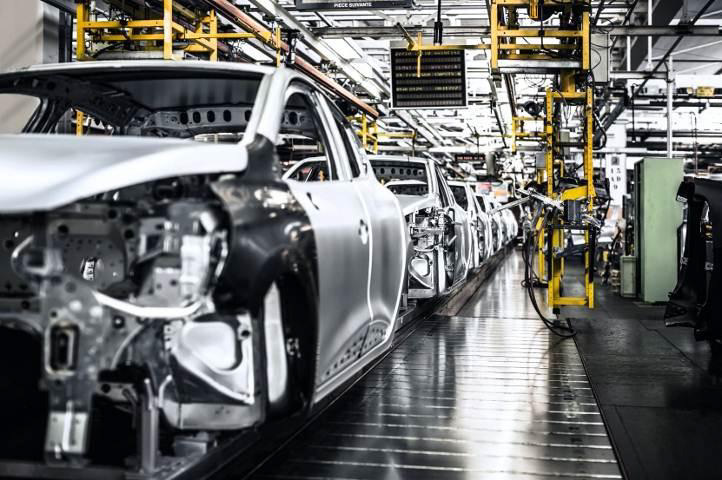
Production of ZOE, the flagship of Renault’s electric vehicle range, started at the end of 2012 on the same production lines as New Clio and Clio Collection. The industrial development of ZOE was a tough challenge for Flins, but the plant succeeded in launching the series production of two very different and strategically important vehicles for the company, ZOE and New Clio, at the same site and in the same year. The people at Renault showed outstanding ingenuity to minimize changes to production resources and cope with the specific demands of electric ZOE in the manufacturing process in a totally fluid manner. The production processes of the ZOE and New Clio body shells are so similar that it takes a carefully trained eye to spot the differences between the two.
Flins Production Line (Image: Renault)

An almost change-free revolution

The launch of Renault ZOE heralds the start of a new era, in which zero-emission mobility will become broadly affordable. ZOE was designed exclusively for electric propulsion and is crammed with the most advanced electric technology. But its arrival in the plant did not call for that many changes to the means of production. “The arrival of an electric vehicle could have introduced a lot of changes, but we have managed to keep them to a strict minimum,” explains Didier Lehingue, Deputy Director of the plant. That was the goal of the 20-person team tasked with the industrial development of ZOE, headed by David Garreau, when it set to work in June 2009. The team had two years to launch the series production of ZOE on a single line at Flins, while meeting the Brand’s usual standards of quality.

In the first stage, lasting almost one year, the team organized the industrial development process. David Garreau qualifies this phase as “fundamental to defining the basis and finding the optimal industrial organization”. The goal was to find smart solutions, from the design phase through to the production methods, for adapting existing systems and keeping initial outlay under control. For example, the perfectly operational old-generation Acma or ABB robots have been reused. This is called carry-over. After hours of meetings, forecasts and calculations, cost estimates and the development of the end-to-end process, the decisions were finally taken on the technologies and the layout.

Adaptations totally integrated in the manufacturing process

The arrival of ZOE also prompted some larger-scale adaptations. The most radical changes were made in the stamping shop, which produces the opening panels (doors and tailgates). The means of production had to become sufficiently flexible to make opening panels for four different models – ZOE, New Clio, Clio Collection and New Clio RS – instead of just two previously, Clio III and Clio III RS. The white bodies of the RS versions are then shipped to Dieppe, where they are painted and assembled.
Flins Production Line (Image: Renault)

Major works to reorganize and refurbish the workshop were organized in the summer breaks in 2011 and 2012, during which the equivalent of one half of a soccer pitch was totally demolished and cleared. The tools were cut at the base by enormous cutting machines and scrapped, and the concrete floors were broken up and rebuilt. The brand new workshop boasts 550 robots, including 150 additional systems for greater flexibility and for performing ZOE-specific welding operations. To score a 5-star rating in EuroNCAP crash tests, ZOE’s chassis was reinforced to protect the battery installed under the floor. On the assembly lines, this means that 500 extra welds are made on ZOE compared with a conventional vehicle.
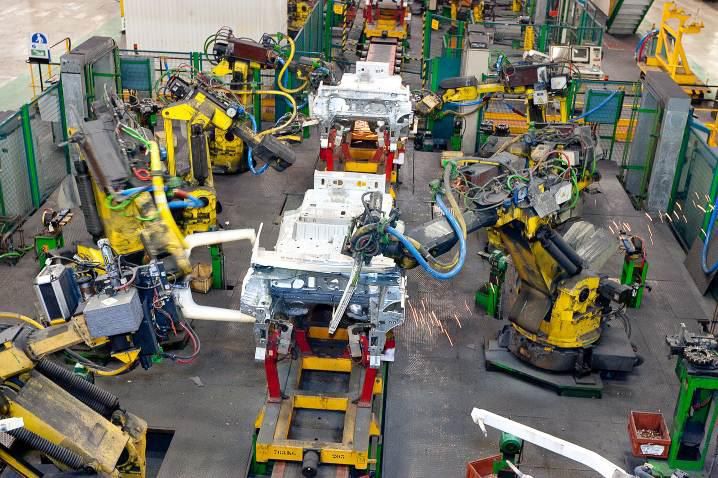
Robot Assembly Cell (Image: Renault)

An extra step has been added at the end of the assembly line, in which the battery is installed in ZOE’s underbody. The production line can switch between Clio Collection and New Clio without making any changes. The three models are manufactured on the same line in a totally fluid manner.
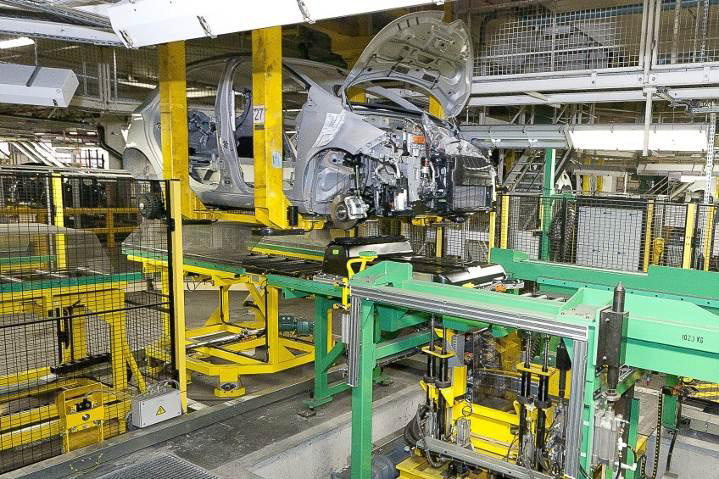
Battery Installation (Image: Renault)

The battery assembly shop: a brand new and technically complex process requiring the highest safety standards

Renault is breaking new ground by assembling the batteries directly at the production plant, in a 500 m² workshop set up from scratch and kept safely under wraps for eighteen months. Another tough challenge for the site consisted in setting up an assembly line using manufacturing processes close to those found on lines producing mechanical subsystems, with operators working on fixed workstations, in a car plant where the operators work on the vehicles as they move along the assembly line. After lengthy discussions, a decision was finally reached on the battery assembly process. The operators will work on the batteries at a standstill in order to guarantee build quality, but for a limited time only, in order to keep pace with the production flow of the vehicles. If they have not finished when their time is up, they can press a button to withhold the battery. Otherwise, the battery moves on to the next workstation.

Battery Assembly Shop (Image: Renault)

The battery assembly shop was designed to meet stringent quality and safety criteria. The workshop is organized more like a white room than a conventional industrial workshop. The project team opted for highly automated processes, in particular for all the operations on the batteries charged to 400V, in order to protect the safety of the operators. A full 34% of the operations are performed by robots, compared with 10% in a mechanical assembly workshop.
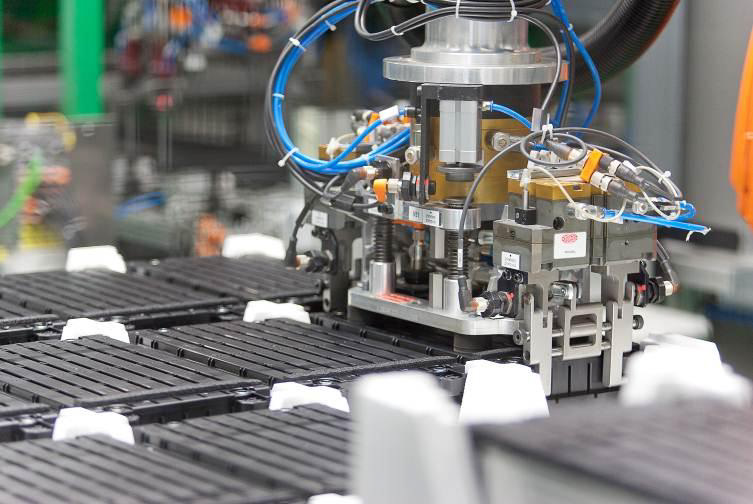
Battery Assembly (Image: Renault)

Every employee in the battery assembly workshop is specially qualified to work in this unusual environment. The workshop is split into two quite separate safety zones: the 60V zone and the 400V zone. Electrical risks are limited by performing most of the manual operations in the 60V zone.

The battery is powered up at the last minute at the end of the line by two specially trained operators. The design office included an opening in the battery housing that is used to connect the modules to one another at the very end of the process.

Battery Assembly (Image: Renault)

The plant makes the two-component assembly seals itself, in order to guarantee the assembly quality of the battery cover. The 5-meter long seal is installed by a robot around the perimeter of the cover and passes between the bolts. A robot scans the position of the bolts and sends the exact path to a second robot, which installs the seal, in order to achieve precision of a millimetric order.

The sealing and the electric functions of all the batteries are then tested, and in particular the charge and discharge cycles. The batteries are then stored, ready to be mounted in ZOE.

The first ZOE rolls off the assembly line

The very first ZOE rolled off the plant’s assembly line in September 2012. It was an important and emotional moment that rewarded all the hard work done by the plant’s personnel. All the plant’s employees were invited to witness the event. Everyone was holding their breath when ZOE arrived at the end of the line, after its 6-hour journey, and entered the 25-meter long light tunnel, where the final inspections are made. The time had come to start the motor. Yvan Nordez, who managed the assembly aspects of the ZOE series production project, received this honor. He sat at the wheel, pressed the starter button and, in complete silence, the lights came on and the car set off, to the applause of employees gathered at the end of the line.
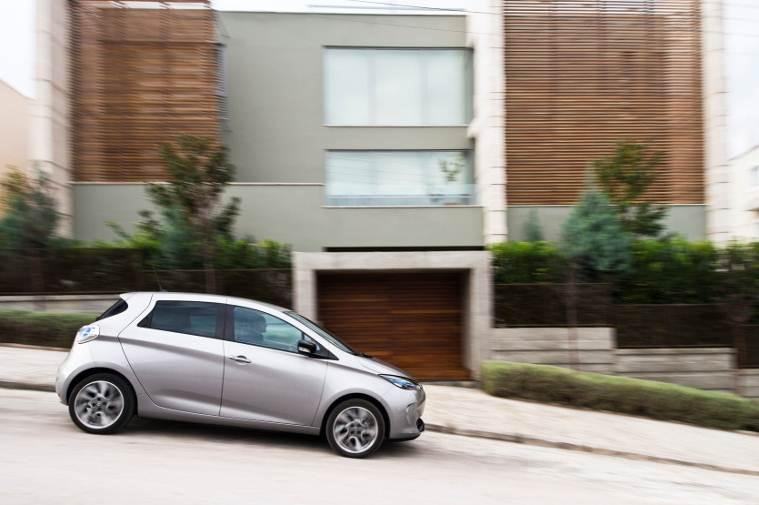
Renault ZOE (Image: Renault)

This event marked the end of the project team’s work and the start of series production for the plant’s 2,800 employees. By March 2013, production was up to full speed, and the full-electric hatchback is now being manufactured for the 11 countries where it will be on offer.
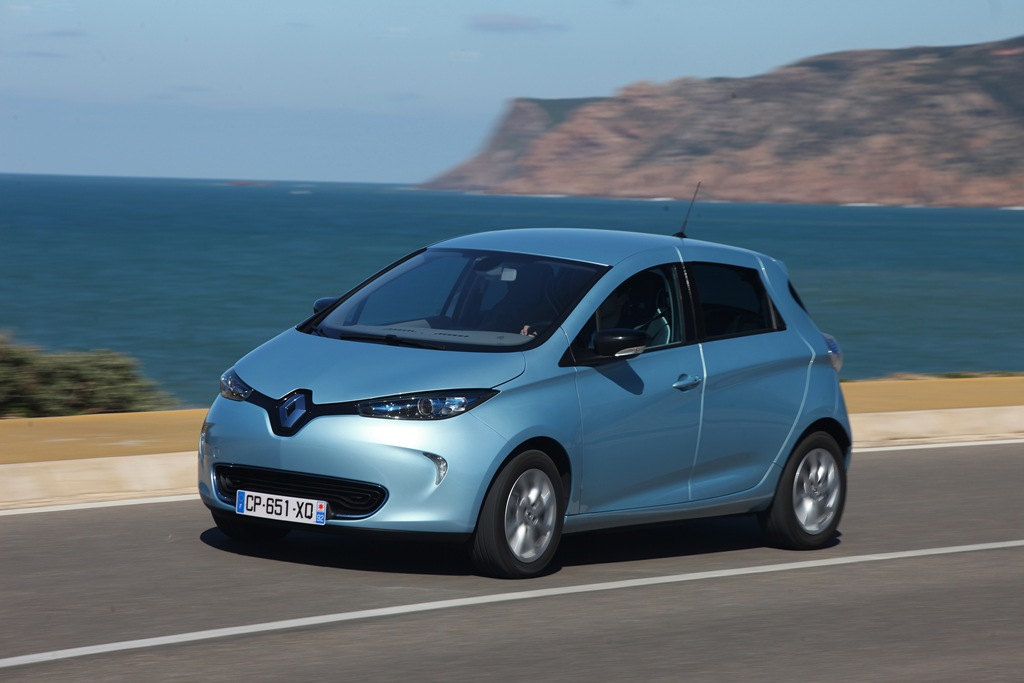
Renault ZOE wins BusinessGreen Green Car of the Year

Blue Renault ZOE by the sea

The inaugural Green Car of the Year award, from respected online publication BusinessGreen has been awarded to Renault ZOE electric car.

Newly launched in the UK, the electric supermini fought off tough competition from shortlisted cars; the Toyota Auris Hybrid, BMW 320 ED Touring, Vauxhall Ampera and Volvo V40 to claim the final prize.

It’s the first year an award has been handed out in recognition of low emission cars, as part of BusinessGreen’s annual Leaders Awards, which aim to recognise businesses and individuals across an array of sectors who make a significant contribution towards achieving a more sustainable economy.

In the Green Car of the Year category, it was the BMW 320 ED Touring which won the Highly Commended position, out of the shortlist of five finalists.

British Gas launches free nationwide electric vehicle charging package

Released on 5 July 2013
[Editor’s note: various links added or corrected]

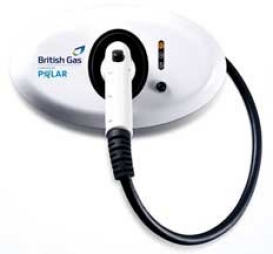
 Data enabled charging point - J1772 (Image: British Gas)
Data enabled charging point – J1772 (Image: BG)

In a move set to make the cost of running an electric vehicle (EV) even more affordable, British Gas – the UK’s leading supplier of residential charging units – has today launched its first free* nationwide charging package to include a home charge point and access to the nationwide POLAR public charging network.

Available from 1st July until 31st March 2015, the package includes* at no extra cost:

• Installation of a home charge point (a 16 Amp data enabled Wall Box to help you keep track of your energy use) and an earthing connection for ensured safety.

• Access to the POLAR network until the end of March 2014. Giving you the use of more than 1,800 public charging points across the country to keep you going on the road.

• A home-suitability survey by a fully-trained British Gas electrician, survey and installation on the same day for your convenience.

• Access to Chargevision online account management and smart phone app to help you easily keep track of your energy use.

• Three year charge point warranty and three year parts and labour warranty

Open to anyone, not just British Gas customers, this offer is jointly funded through British Gas and the Government’s Office for Low Emission Vehicles, with access to the Polar network provided by Chargemaster**.

Andreas Atkins, Head of Electric Vehicle Services at British Gas, said:

“This offer is a milestone for the UK’s electric vehicle market. The number of electric vehicles on the road is predicted to hit 1.5m by 2020*** and the Government funding scheme which makes this offer possible is doing a lot to help reduce the cost of owning an EV even further.

“As the offer is open to anyone it’s a great time for the friends or family of EV drivers to install electric vehicle charge points at their homes. For example, if someone is making a regular journey to and from a relative’s house then having a charge point at both destinations could be worthwhile.”

David Martell, Chief Executive of Chargemaster Plc commented:

“Chargemaster is pleased to work with British Gas on this project. Providing free Homecharge Units and free membership of POLAR is a great opportunity for EV owners to get the most out of their electric motoring.”

British Gas electric vehicle charging points offer a safe, convenient and compatible way to charge your electric vehicle at home. With expertise in the electric vehicle market, British Gas can advise on and install the ideal solution for your specific needs, leaving you with the best way to charge your electric
vehicle.

In order to receive a free electric vehicle charging package, people can visit
www.britishgas.co.uk/electricvehicles

*Terms and conditions
1. To receive this free offer you will need an O2 data network connection which will be used to collect your usage data. The British Gas electrician will run tests during your survey to check your eligibility.

2. Access and usage of POLAR public charging network available across UK at no additional cost. This offer is subject to availability and any proposed offer end date will be published in advance. To find out what’s included in this offer, refer to the frequently asked questions section on the British Gas website. This offer is only valid in mainland UK and excludes the Channel Islands and Isle of Man. For full terms and conditions applicable to this offer please click here.

3. Chargemaster reserves the right to review this pricing structure on an individual basis with 30 days notice.

4. Chargemaster products, including all components and accessories shall be fully guaranteed against all defects arising from faults in design, manufacture and workmanship for a period of 36 months from delivery of charging points/s. Anything else is excluded. Applies to mainland UK only.

5. British Gas guarantees all parts and labour for 36 months from the date of any repair/fitting. Any guarantees do not affect your legal rights under the Sales of Goods Act 1979 and Supply of Goods and Services Act 1982. You can get advice about your rights from a Citizens Advice Bureau or Trading Standards Department.

6. **Chargemaster Plc is one of the most successful charging systems manufacturers in Europe and operates the POLAR national charging network in the UK. It has a range of 22 products meeting the needs of every sector of the market. This year it has supplied charging solutions to over 15 European countries including France, Ireland, Belgium, the Netherlands, Italy, Austria, Germany, Switzerland and Denmark as well as being the largest supplier in the UK.

*** According to EC clean fuel strategy 2013

Renault-Nissan CEO sees 100,000 electric vehicles sold end-June

An employee inspects a Renault Zoe electric car on the production line at the Renault automobile factory in Flins, west of Paris, May 28, 2013. (Image: Reuters/Benoit Tessier)

(Reuters) – French carmaker Renault and its Japanese partner Nissan will have sold a total of 100,000 electric vehicles so far by the end of June, Carlos Ghosn, chief executive of both companies, said on Saturday.

But Ghosn, speaking at a conference in the southern French city of Aix-en-Provence, also said he did not expect any strong recovery in the troubled European auto sector in the medium term.

Renault launched electric car Zoe earlier this year in France, where it has sold more than 3,000 units so far, and began marketing it in other European markets on June 6.

Ghosn told reporters on the sidelines of the conference:

“The Zoe is selling well. Obviously we are always impatient to see higher volumes but we have already sold more than 6,000 units in Europe.”

Renault UK Press Release: Pioneer spirit at the 2013 Goodwood Festival of Speed

THURSDAY 4TH  JULY 2013 

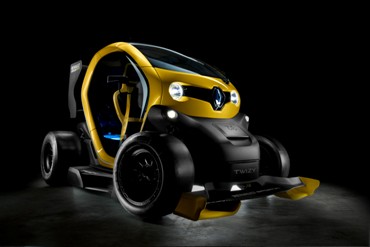
Twizy F1 (Image: Renault)

[Editor’s Note: this release has been edited to focus on Renault’s electric vehicles]

This year’s Goodwood Festival of Speed sees Renault following its substantial 2012 appearance with a celebration of its highly successful, 36-year long commitment to Formula 1, a tribute to the Alpine’s successful motorsport record and the showcasing of an exciting array of new road cars, including two new concept models. The event will be held from 12th to 14th July in the grounds of Goodwood House, 60 miles south of London.

  • Renault’s pioneer spirit is amply demonstrated by landmark vehicles from its sporting 115-year history, including the 1978 RS01 that was the first turbo F1 car, the sensational 1978 Le Mans-winning  Alpine A442B, the 1977 Groupe 5 Alpine A310 rally car that is running for the first time since 1977, the enormous and extraordinary-looking 1926 Renault 40CV ‘des records’, a 1902 Renault Type K that was one of the world’s earliest racing cars, and the dramatic Renault 5 Maxi Turbo of 1984.
  • Making their UK debut at Goodwood, and guaranteed to draw crowds, will be two new sports concept cars, Twin’Run and the 100% electric, Twizy Renaultsport F1.
  • In 36 years of Formula 1, Renault engines have won 11 constructor’s championships.  At Goodwood, Renault will showcase the four examples of Renault RS27-powered F1 cars from the 2013 championship, including the race-winning Lotus E21, the Red Bull RB9, the Caterham CT03 and the Williams FW35, as well as an array of exciting new road cars. These include the much-anticipated Clio Renaultsport 200 Turbo EDC, the handsome new Renault Captur crossover and the stylish 100% electric Renault ZOE.
  • Senior executives and famous drivers will be at Goodwood and available for interview, including Stephen Norman (Senior Vice President, Global Marketing), Axel Breun (Head of Concept Car Design), Patrice Ratti (Managing Director, Renaultsport Technologies), Bernard Ollivier (CEO, Alpine Caterham), Jean-Pascal Dauce (Engineering Director, Alpine Caterham), Rob White (Deputy Managing Director Renaultsport F1), Jean-Michel Jalinier (President, Renaultsport F1), legendary four times F1-championship winner Alain Prost and Monte Carlo rally winner Jean Ragnotti.


Goodwood: Racing through time and a country house garden

Renault has long been an enthusiastic participant in the Goodwood Festival of Speed, appearing on six consecutive occasions from 2001 to 2006, before making a comeback in 2012 after a five-year break. The company’s 2013 appearance coincides with the 20th anniversary of this now world-famous and much-loved event, and promises to be one of the most eye-catching yet.

Held in the grounds of Goodwood House, an elegant and historic country residence nestling amid England’s picturesque South Downs, the Festival provides the startling sight of racing cars charging through its bucolic grounds, the house’s driveway turned into a dramatic, challenging and rather beautiful hillclimb venue.

Racing cars and Goodwood have been synonymous for decades, the first motorsport event occurring in 1936 when the ninth Duke of Richmond organised a hillclimb through the house’s grounds. World War 2 brought this pursuit to a close, but also saw the construction of a nearby airfield whose perimeter road would eventually be turned into the famous Goodwood circuit. The first race was held in 1948 and the last in 1966, and when the Charles Gordon-Lennox, the current Earl of March and a major car enthusiast was prevented from reviving races at the circuit, he decided to stage his own Festival of speed in the grounds of Goodwood House. The first event attracted 30,000 visitors, and it now draws 180,000, many considering it the finest motoring event in Britain.

Besides the hillclimb there is also a concours d’elegance, a pavilion of concept cars and technical exhibits of the future, an air display, events for younger visitors and much more. A highlight of the event remains the paddock, where fans can stand mere inches from some of the most famous racing cars in history and better still, meet their drivers.

Two exciting Renault concepts make their UK debut at Goodwood 

Renault Twin’Run

Twin’Run previews Renault’s next city car and, with a mid-mounted 320hp V6, pays homage to the legendary mid-engined R5 Turbo and Clio V6. “Twin’Run is a cocktail of energy, passion and athleticism, rekindling the memory of emblematic Renault racing cars,” says Laurens van den Acker, Senior Vice President, Corporate Design at the Renault group. “Following its twin, Twin’Z, a stylish urban concept car, Twin’Run shows that personalisation is a core strategy at Renault.”

Renault Twizy Renaultsport F1

An entertaining blend of the cute, tandem two-seat electric Twizy – Europe’s best-selling EV – and Formula 1 hardware, the Twizy Renaultsport F1 not only looks the part but has the technology to go with it. Besides a spectacular, track-inspired look that includes slick tyres, a front splitter, sidepods, a rear wing and an F1-style red rain light, this Twizy features a complete Formula 1 Kinetic Energy Recovery System (KERS) capable of an instant, six-fold energy boost to produce almost 100hp. And with the Twizy’s low weight, that is enough to propel it to 62mph in the same time as a Mégane Renaultsport 265.

This technological gem is the inspired product of a collaboration between Renaultsport engineers and their colleagues at Renaultsport F1 and besides producing a smile, showcases Renault’s expertise in Formula I electric technology, particularly in the KERS field. The system is designed to recapture some of the kinetic energy lost under braking. Rather being lost in the form of heat, this energy is stored before being used to momentarily boost the total available power, exactly as it does for a Grand Prix car. This boost is available for up to 13 seconds, at which point the Twizy’s electric motor will be revving at 10,000rpm, while the KERS unit can rev as high as 36,000rpm. The challenge of connecting the two units is achieved via 1:3.6 reducer gear which uses the same drive gear as the Renault V8 F1 engine. And to prevent the KERS battery from overheating, it’s equipped with water cooling. Other eye-catching features of the Twizy Renaultsport F1 include an adapted F1 steering wheel, a data-logging system and the KERS hardware itself, which is visible through a transparent panel.

‘When Renaultsport F1 asked us to work on the project, our engineers didn’t hesitate,’ says Renault Sport General Manager Patrice Ratti. ‘Renault Sport Technologies had already made a significant contribution to the design and development of the highly innovative Renault Twizy which meant that our input was perfectly natural.  Thanks to our experience of race car engineering, we were able to take elements from our Formula Renault 2.0 and 3.5 race cars and also check that the rigidity of Twizy’s chassis and suspension was capable of handling the additional 60kW.  We enjoy a very close working relationship with Renaultsport F1 and we were able to combine the ‘fun’ side of the project with some very advanced technology. We are very proud of the result.’

And this rapid and highly entertaining electric Twizy will be seen startling onlookers with its sci-fi sound enthusiasm on the Goodwood hill.


On static display

1993 Williams Renault FW15C ex-Prost

1993 Renault Clio Williams

2013 Renault Clio Renaultsport 200 Turbo EDC

2013 Renault Mégane Renaultsport Red Bull Racing RB8

2012 Red Bull RB8

2013 Renault ZOE

The elegantly stylish ZOE is unusual for being a purpose-built electric car, allowing it to be perfectly optimised for practical zero-emission performance. This five-door, five-seat car delivers effortlessly restful, near silent performance, excellent acceleration, a very convenient range and a clever charging system allowing rapid recharges of the battery pack. It also comes with a sophisticated navigation system and Bluetooth as standard. Zero emissions and ultra-low running costs are just some of the advantages of this charming and highly sophisticated car.

2013 Renault Captur

1924 Renault Type MH ‘Pioneer Spirit’ 6-wheeler


In the Cartier Style et Luxe

1933 Reinastella

On the cricket pitch (land record cars)

1956 Renault Etoile Filante


Excitement on the track means excitement on the road

Renault will showcase no less than three major new models at Goodwood this summer, including the much-anticipated Clio Renaultsport 200 Turbo EDC, the stylish new Captur compact crossover and the revolutionary electric ZOE. Not only that, but there will also be two previously unseen, performance-oriented concepts on show, one of which will be 100% electric.


Capturing eyes

Just as eye-catching is the Renault Captur, a new and particularly stylish supermini crossover that combines the high-set seating of an off-roader with the space and versatility of a small MPV, and the handy manoeuvrability of a small hatchback besides. An athletic stance that positions the wheels sportily close to the bodywork, doors shaped to prevent shoes and clothes from getting muddy when you step in and a colourful, high quality interior finish underline the attention to detail that characterizes this car. Handy features include optional unzippable seat covers, a sliding rear seat, a multi-position boot floor, and Renault’s new R-link infotainment system.

Like the new Clio and the ZOE, the Captur is a striking car, and Renault’s chief designer Laurens Van Den Acker will be appearing at this year’s Goodwood Festival of Speed to explain his already widely admired design strategy for the marque.

Electric Style

Just as distinctive as the Captur is Renault’s stylish new ZOE, an electric car that promises to attract new buyers to this growing segment. With prices starting at only £13,650 after the government’s subsidy, the ZOE is the most affordable, purpose-designed electric car on the market. It also has the biggest range, which is officially homologated at 130 miles, and has also been awarded the full NCAP five stars for occupant protection. A five-door hatchback of particularly appealing lines, the ZOE debuts no less than six ‘world premiere’ features and carries 60 patents, all of them aimed at enhancing its range, user-friendliness and connectivity.

A 65kW (88hp) electric engine provides the ZOE with particularly strong low-speed acceleration thanks to its instant 220Nm of torque, while its top speed is limited to 84mph. Recharging takes between 30 minutes and nine hours using Renault’s patented Chameleon charger, which is compatible with both the fast-charging stations that provide a fast 30 minute charge, and a domestic overnight supply.

ZOE is available in three trims levels called Expression, Dynamique Zen and Dynamique Intens, all three including the Range OptimiZEr package that provides regenerative braking, a heat pump and Michelin Energy E-V tyres, all three features contributing to the 130 mile NEDC range that, in real world use, would be typically around 90 miles in temperate conditions. Battery pack rental costs from just £70 a month, and in combination with the low cost of the energy required to charge, makes the ZOE very cheap to run.  Renault has become the first car manufacturer to offer a free domestic charging point with a new electric car purchase.  The free Single Wall-box, supplied and installed by Renault’s preferred electric vehicle charging partner, British Gas, is supplied and installed free of charge to ZOE customers.

R-Link super-connectivity

Apart from their style, a common feature to the Clio Renaultsport 200 Turbo EDC, the Captur and the ZOE is Renault’s innovative and hugely useful new R-Link infotainment system, which provides an impressive level of connectivity for the drivers of these cars. This multi-media tablet is also available in the new Clio hatchback and the new Kangoo van range too. Either fitted as standard or available for a very reasonable £450, this impressive and attractive tool is designed to appeal to those with an interest in new technologies, and equally, to be useful and easily understood for those that aren’t.

A key aim behind its design has been to avoid the need to use a small pile of portable devices to make phone calls or listen to music while on the move. So R-Link provides Bluetooth telephony, navigation, a radio, music streaming and connectivity to music devices, as well as connection to a series of vehicle-related services. Customers can tailor R-Link to suit their particular needs by subscribing to a variety of services – including TomTomLive – and downloading as many as 50 apps. The system itself is controlled by a clear and intuitive touchscreen, a set of steering wheel-mounted controls and a series of voice commands to ensure that the driver’s eyes remain on the road. R-Link is one of the most advanced and attractive infotainment systems on the market, and one of the most affordable too.

Some of its more unusual features include an app allowing you to compare the prices of the nearest 10 fuel stations, an Eco-coaching programme, a Yellow Pages search and when the car is stationary, the ability to tweet or play Sudoku. And for drivers of electrically-propelled Renaults, it helps you optimize your range, route and battery charge, and can guide you to the nearest charging station using TomTom Z.E. Live navigation.