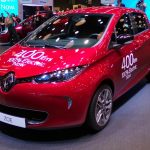
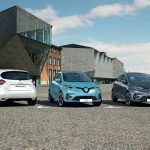
Zoe in World Distance Record Attempt (Photo: Renault)

The ZOE Range Rule

ZOE Range = (1000 / Speed) 2

– where Range is in km and Speed in km/hr, and Speed is from 30km/hr to 140km/hr


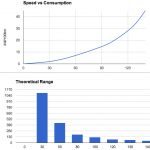
I found the data provided by Nosig in Maximising Range in a ZOE very interesting, particularly with regard to how ZOE range is affected by speed. Having done some line fitting on it I believe I have discovered a useful method of predicting the maximum range achievable for a given speed for the ZOE.

To a good approximation it can be summarised by the equation above. In other words, to work out the approximate maximum range at a particular speed you just divide the speed into 1000 and square the result!

This ‘ZOE Range Rule’ is actually simple enough to do in your head while driving along (at least roughly) so you can choose an appropriate speed if required to get to a particular destination – here are some examples:

  • Range at 125km/hr (78mph) = (1000/125)^2 = 8*8 = 64km (40 miles)
  • Range at 100km/hr (62mph) = (1000/100)^2 = 10*10 = 100km (62 miles)
  • Range at 50km/hr (31mph) = (1000/50)^2 = 20*20 = 400km (250 miles)


The second one is particularly easy to remember – the ZOE can travel about 100km at 100km/hr. That’s not an impressive range – but drop the speed and the range can go up hugely.

Of course, these predicted ranges are all approximate and represent the best achievable range (i.e. travelling at constant speed on level ground). With further experimentation and data gathering it should be possible, firstly, to validate and refine the approximate rule above and, secondly, to make a more general model to calculate range taking into account more key variables (e.g. type of route, altitude changes, number of passengers, etc.).

Home Forums The ZOE Range Rule

This topic contains 3 replies, has 3 voices, and was last updated by  farblue 12 years, 7 months ago.

Viewing 4 posts - 1 through 4 (of 4 total)
  • Author
    Posts
  • #4650

    Trevor Larkum
    Keymaster

    ZOE Range = (1000 / Speed) 2 – where Range is in km and Speed in km/hr, and Speed is from 30km/hr to 140km/hr I found the data provided by Nosig in Ma
    [See the full post at: The ZOE Range Rule]

    #4677

    Electric Ali
    Participant

    Having been driving a Leaf (sorry Trevor) for the last 5 months or so, I can confirm that range depends on many, many things – not quite whether there is an “r” in the month or not, but not far off!

    I have found this document helpful

    http://dl.dropboxusercontent.com/u/35284720/postfiles/leafcharts/LEAFrangeChartVersion7G100.pdf

    perhaps in time something similar will appear for the Zoe?

    I recently did a trip to Ben Chonzie and got to the destination with 8 miles of range left on the Leaf range guess-ometer (1 range bar), with the nearest charger 20 miles away (a bit silly, I know!). But, knowing that I was at a much higher elevation than the charger, that the range estimate was a guess based upon recent driving i.e. going uphill rather than down and that I could travel quite slowly on the road back to the charge point, I was confident that there wouldn’t be a problem. And there wasn’t. By the time we had come back down the single track access road (after climbing Ben Chonzie and with lots of regeneration) the range guess had gone up to 12 miles with 17 miles to the charge point. The rest of the journey was at about 35 mph to try to get good range without being too anti-social. With 2 miles left to the charge point, the range at 3 miles now exceeded the distance left to go. We got to the charge point, plugged in and went for dinner before returning home.

    However, having got away with it this time, I wouldn’t like to sail quite so close to the wind in future!

    #4679

    Trevor Larkum
    Keymaster

    Don’t worry, Ali we forgive you – at least it’s an EV!

    That chart is very interesting, I’ve downloaded it to study.

    The ZOE shows estimated range and approx. charge while you’re driving, but shows the actual percentage of charge when you start up – is the LEAF similar?

    #4682

    farblue
    Participant

    I’ve converted the simple rule into an excel spreadsheet that allows you to specify a number of sections of a journey as defined by average speed (in mph) and duration (in mins). Basically it just works out the total range at the specified speed and then the % of that total range you would be using based on the time you specify (and so, therefore, the distance). It then just sums the %’s.

    The link to the spreadsheet is here:
    http://cl.ly/07413H1t1F20

    No idea how long the link is valid for!

    The core of the spreadsheet is the calculation that converts speed in mph and duration in mins into the % range used. It is a very messy equation because I just started with the separate components and then munged the entire thing together:

    100/((1000/(1.6*[speed]))^2)*(([speed]*1.6)*([duration]/60))

    I’m sure someone with a bit of time can tidy it up 🙂

    Breaking the calculation down into parts it works as follows:

    * Convert the speed to kph: 1.6*[speed]
    * Apply the above rule to get the total range: (1000/(1.6*[speed]))^2
    * Calculate the distance covered in km from the speed in kph and the time in h:([speed]*1.6)*([duration]/60)
    * Calculate the % of the total range used by the distance travelled

    I’ve included 3 rows in the spreadsheet representing my drive home from work – first a short time driving to the motorway, followed by the motorway followed by driving through south Birmingham.

    What is interesting to note is how changing the 30mph sections in speed or time has very little impact on the overall range used in the journey (and, of course, you won’t actually manage 30mph in the city and neither is regen taken into account) but changing the motorway speed from 60mph to 70mph eats a massive 18% extra range.

    I hope people find the spreadsheet useful! 🙂

Viewing 4 posts - 1 through 4 (of 4 total)

You must be logged in to reply to this topic.