Renault Enters the New FIA Formula E Championship

TECHNICAL PARTNER TO THE FIA FORMULA E CHAMPIONSHIP –

RENAULT STEPS INTO THE ERA OF ELECTRIC MOTORSPORT
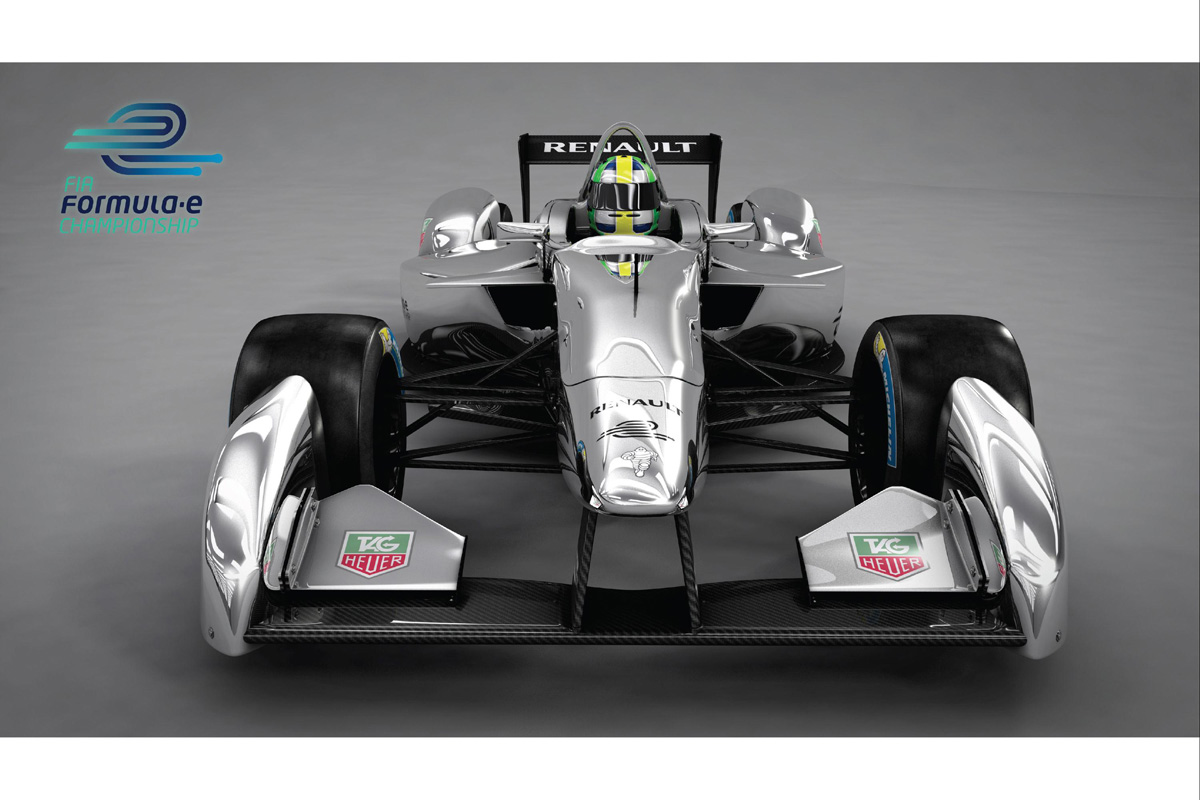
Spark - Renault SRT 01E (Image: Renault)
Spark – Renault SRT 01E (Image: Renault)

A leader in electric vehicles with its Z.E. range and boasting unique expertise in motorsport, Renault is entering the new FIA Formula E Championship. The ten teams racing in the competition, which kicks off in September 2014, will drive the Spark-Renault SRT_01E single-seater, co-designed with Renault Sport and world revealed at Frankfurt.

A new era in motorsport

As a testing ground for new technology, motorsport was bound to embrace electric power sooner rather than later and an initiative from the International Automobile Federation (FIA), the new Formula E competition, is exploring a different path with full-electric, zero-emission single-seaters.

The first Formula E Championship will be held from September 2014 to June 2015. The competition will be organised in ten legs, each one raced in the centre of a major city in Europe (London, Berlin, Rome), Asia (Beijing, Bangkok, Putrajaya) or the Americas (Los Angeles, Miami, Rio de Janeiro, Buenos Aires). For this first season, 20 drivers split up in 10 teams will meet in each race.

Bringing together the biggest names in motorsport

Formula E holdings, instigator of the FIA Formula E Championship, designated Spark Racing Technology to conceive and manufacture the first 40 single-seaters racing. The cars are homologated according to regulations on performance, safety and costs, which means that other carmakers will be able to get involved. To develop the cars and put them into production, Spark set up a consortium featuring the biggest names in motorsport:

–       Renault: responsible for the electric drivetrain, system integration, performance optimisation and the safety of the electric drivetrain,

–       McLaren Electronic Systems: development, production and assembly of the powertrain and electronic controls,

–       Williams Advanced Engineering: battery design,

–       Dallara: monocoque design and construction,

–       Spark: design of the single-seater (suspension, aerodynamics, assembly).

As Spark’s technical partner, Renault drew on all the skills of the engineers at Renault Sport Technologies and Renault Sport F1 to supervise and optimise the performance and safety of the new car.

Spark-Renault SRT_01E: a concentrate of technology

The Spark-Renault SRT_01E combines the most advanced technologies in electric drivetrains and boasts innovative styling. The vehicle’s aerodynamics were designed to make overtaking easier, while the relatively high ride height was developed for use on the urban circuits in the Formula E Championship. The car meets current Formula 1 regulations.

Like the driver, the battery has its own survival cell. The battery weighs 200 kg and is homologated according to international transport standards. The electric motor delivers 200 kW, or 270 hp, to the rear wheels. Drivers will be allowed to use the full power output of the vehicle in qualifying sessions. During the races themselves, power will be limited to 133 kW, or 180 hp, with a “push-to-pass” mode bringing drivers temporary access to 200 kW (270 hp), the aim being to combine range with overtaking opportunities.

The designers succeeded in limiting vehicle mass to internal-combustion car levels, with the Spark-Renault SRT_01E weighing in at a minimum 800 kg with the driver on board. Performance simulations put the car’s 0 to 62 mph time at three seconds, while top speed is limited to 200 km/h for maximum safety in urban racing.

“We were enthusiastic about this project right from the start because it gave us a chance to explore new paths. No-one had ever designed an electric single-seater with this kind of performance, manufactured in short production runs and developed according to a tight deadline.  We factored in a number of constraints, including mass, safety and thermics. Harnessing the complementary skills of the consortium members, the Spark-Renault SRT_01E is an excellent synthesis of current knowledge. We are sure that it will prove to be a stand-out single-seater in motorsport history.”

François Champod, motorsport technical director at Renault
Sport Technologies and Formula E coordinator at Renault

ZOE Achieves 160 Mile Range (260km)


I was very pleased recently to eke a range of 111 miles from my ZOE on one charge, but this record – if it ever was one – did not stand for long.

A Spanish website has an article and video describing a trip in a ZOE that managed a full 263km (about 160 miles) on a single charge. This is an impressive achievement that I don’t currently feel confident I could beat.

I will do some planning and practice before I attempt another range record – but it is encouraging to know the kind of distance that can be achieved, particularly as it appears to have been done in a fairly typical urban situation, not on a test circuit or similar idealised environment.

Autopista.es – Zoe Challenge

(Hat tip to Nosig on the forum)

Renault Group, number one in Europe for low CO2 emissions

THURSDAY 5TH SEPTEMBER

Renault Group, number one in Europe for low CO2 emissions

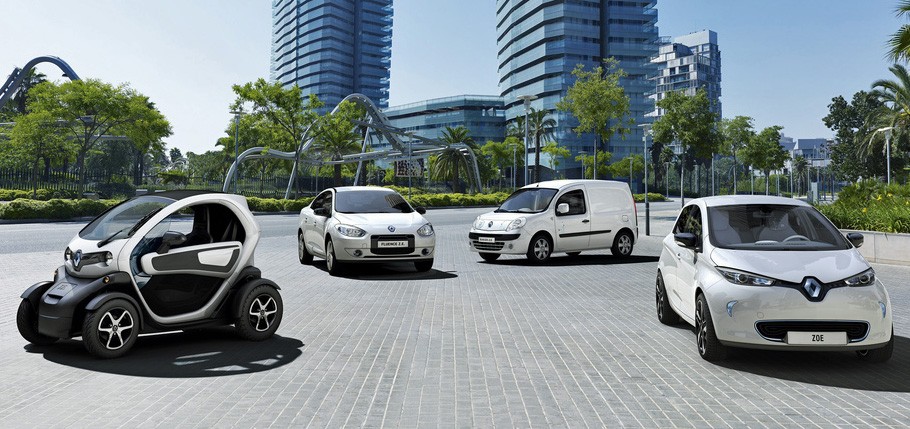
The Renault Range of Electric Vehicles (Image: Renault)

Renault Group has become the European leader in terms of low CO2 emissions based upon its sales of passenger cars over the first half of 2013. This ranking is the fruit of the rejuvenation of its range, the success of its Energy range of engines and the growth of its electric vehicle sales.

Renault Group has moved into pole position in Europe in terms of low CO2 emissions, with an average of 115.9g of CO2/km* per vehicle (source: AAA-DATA**) based on its passenger car sales over the first half of 2013.

Renault Group owes this performance to the recent rejuvenation of its ranges, notably including five models that return less than 100g of CO2/km (Twingo, New Clio, Captur, Mégane and Dacia Sandero). Indeed, in the small five-seater diesel car sector, New Clio Energy dCi 90 eco² is the class leader with 83g/km. Overall, the New Renault Clio range emits 18.5g of CO2/km less than the model’s previous generation.

Meanwhile, Renault is Europe’s number one brand for electric mobility, and its electric vehicle sales have also contributed significantly to the Group’s low average CO2 emissions.

Taken as a whole, the average level of CO2 emissions per kilometre across Renault Group’s entire range has improved by nearly 10g in the first half of 2013 over 2012, falling from 125.5g/km to 115.9g/km.

“This position of market leader is proof that the combination of our powertrain strategy – with our range of Energy engines – and our electric vehicle strategy is bearing fruit. Thanks to these innovations, Renault Group is achieving tangible results and maintaining its objective to significantly reduce the long-term environmental footprint of its activities. At the same time, these improvements are beneficial for both the planet and our customers.”

(Jean-Philippe HERMINE, Director, Renault Group, Environmental Plan)


* The average homologated NEDC combined-cycle CO2 emissions of Renault Group passenger cars registered during the first half of 2013 across 23 EU nations (all countries except Cyprus, Malta, Romania and Bulgaria).

** Figures obtained from AAA-DATA (Association Auxiliaire de l’Automobile), a subsidiary of CCFA. AAA-DATA is an organisation that collates automotive industry data for authorities.

ZOE Keeps Her Promise: 111 Mile Range (180km)

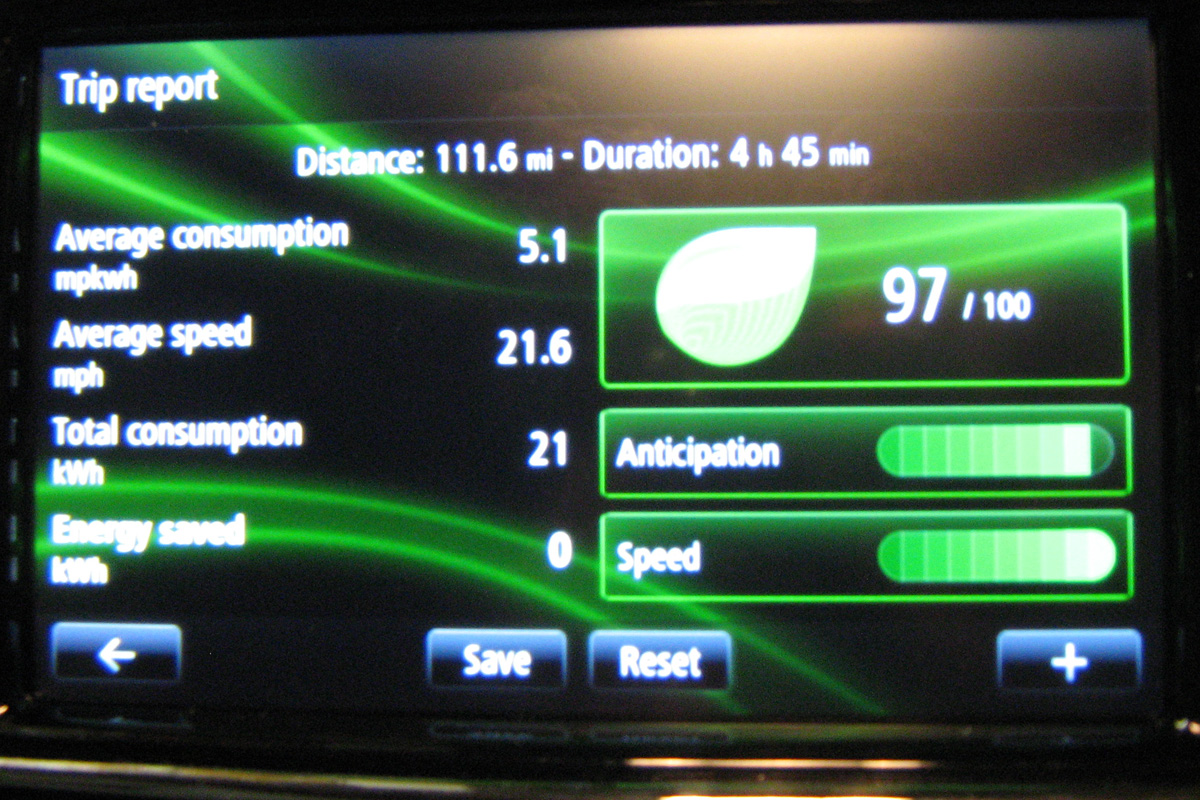
ZOE Keeps Her Promise: The Trip Report (Image: T. Larkum)

On the first day with our ZOE we managed a leg of the journey that was 85 miles long, with 10 predicted miles remaining for a total of 95 miles. A fortnight later it went 64.5 miles with 35 predicted miles so promising a magic 100 miles. Clearly, it seemed to me, the ZOE was telling me it’s capable of long distances if I just trusted it.

So this week I decided to have a first go at testing the ZOE’s range for real. I charged it last Friday evening, and over the weekend it made a few short trips for a total of about 10 miles. The plan was simple – my journey to work is about 20 miles, so two days at work would add 80 miles, for a total of 90 miles, which would get me close to the magic 100 mile total if I just did a bit of driving around town on my return. All driving would be in Eco mode, but with air conditioning on as the weather is very warm at the moment.

And so it turned out, pretty much to plan. I limited my speed to 40/50mph on Monday and could see I was getting better range than usual. Yesterday morning I limited it to 35/40mph and arrived at work having done about 70 miles, with 30 miles remaining for the 20 mile return journey. I drove home yesterday evening with the speed limited to 30mph, even though I didn’t need to, because I could see I was on track for a very good range and started to get intrigued to see what range I could achieve.

Of course, having reduced the speed, after driving home 20 miles the 30 mile promised range remaining had only dropped to 20. That takes some getting used to – the range prediction is impressively accurate and very useful, but if you improve your driving style, as I was doing by driving each leg of the journey more slowly than the previous one, the total range keeps extending and it feels like a moving target that is continually moving away from you.

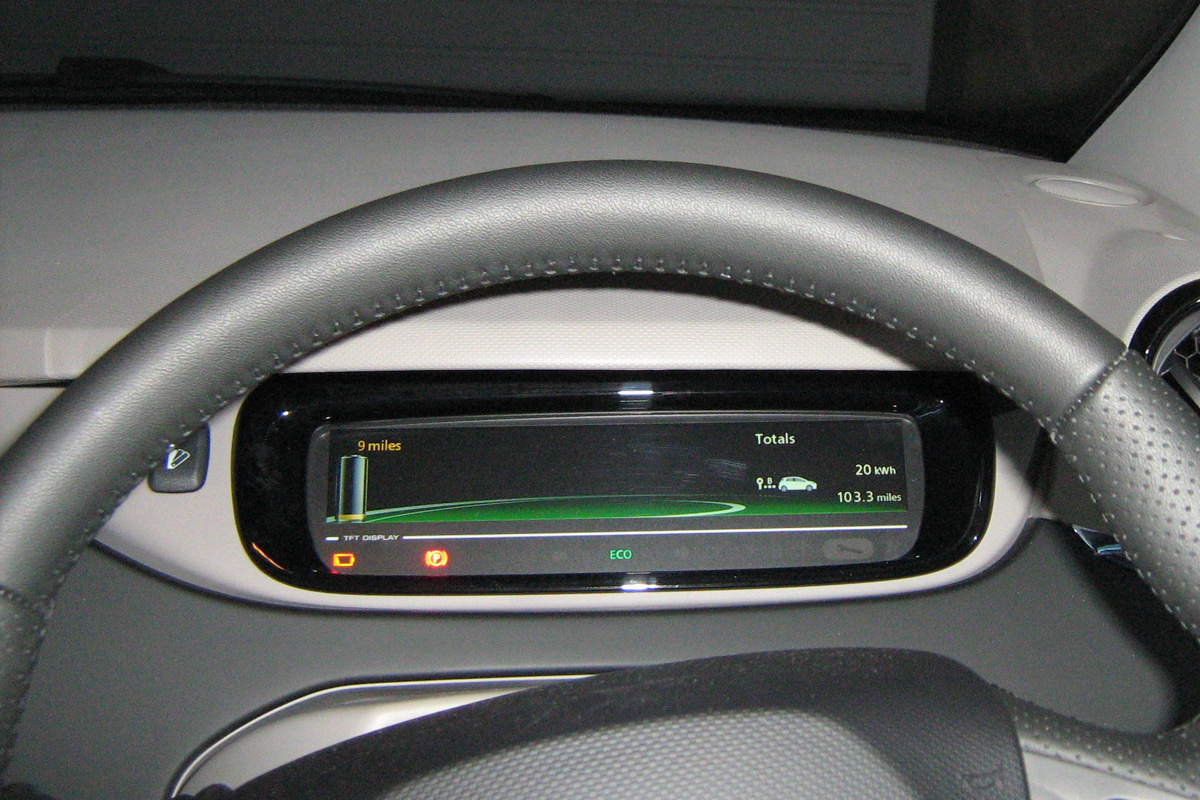
I went shopping and then just drove around the local area to use up the remaining range to see what could be achieved. When the energy used reached about 19kWh (equivalent at that point to 14 miles of range) the low battery warning light came on at the bottom of the dashboard, and the battery indicator turned amber. That was fine, it was what I was expecting, and I was close to home with a fair range left (the battery officially holds 22kWh).

Low Battery Warning at 20kWh: Amber icon, text and battery (Image: T. Larkum)

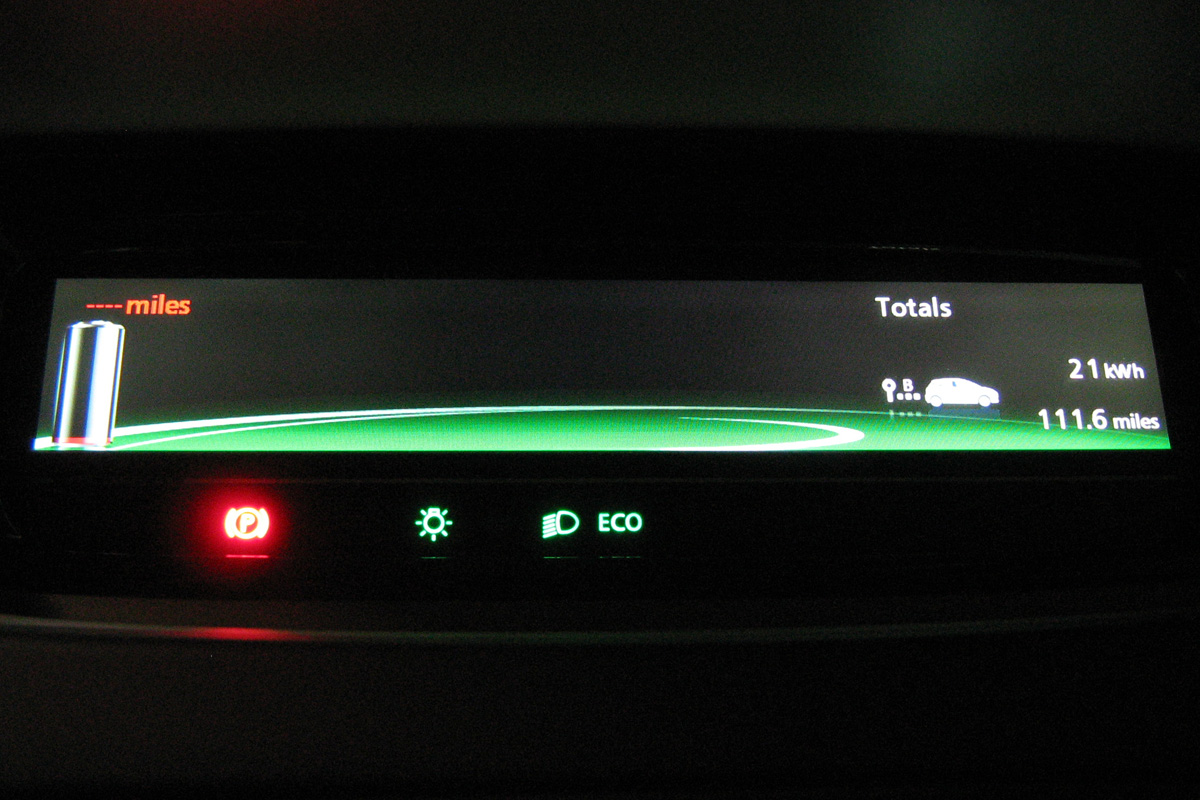
I continued to drive around and went some distance from home, then turned around at the point where I expected to get home with just a couple of miles of range left. However, at the point where the energy used reached about 21kWh (equivalent at that point to 6 miles of range) the car went into ‘turtle’ mode – the low battery warning light started flashing, the battery indicator turned red, and I had a reduced ability to control the speed of the car (by this point the speed restrictor was set to 20mph, but now I no longer had full control over setting its speed).

Arriving home in turtle mode: 21kWh used, flashing battery icon, red text and battery (Image: T. Larkum)

Suddenly it felt like I had made a mistake and pushed the experiment too far. The remaining range prediction changed from displaying 6 miles to just showing a line of dashes, and that was somehow extremely disconcerting, having no indication of whether there was sufficient charge to get home or not. Furthermore the main charge used display is in whole numbers so there seemed no apparent way of knowing whether “21kWh” really meant close to 21kWh or close to 22kWh (i.e. completely empty).

This concern was not helped by me receiving an automatic text alert on my Blackberry saying: “Battery level of your vehicle is low: 6%” – courtesy of the Notification Settings I had forgotten I’d set up on my Z.E. Online account.

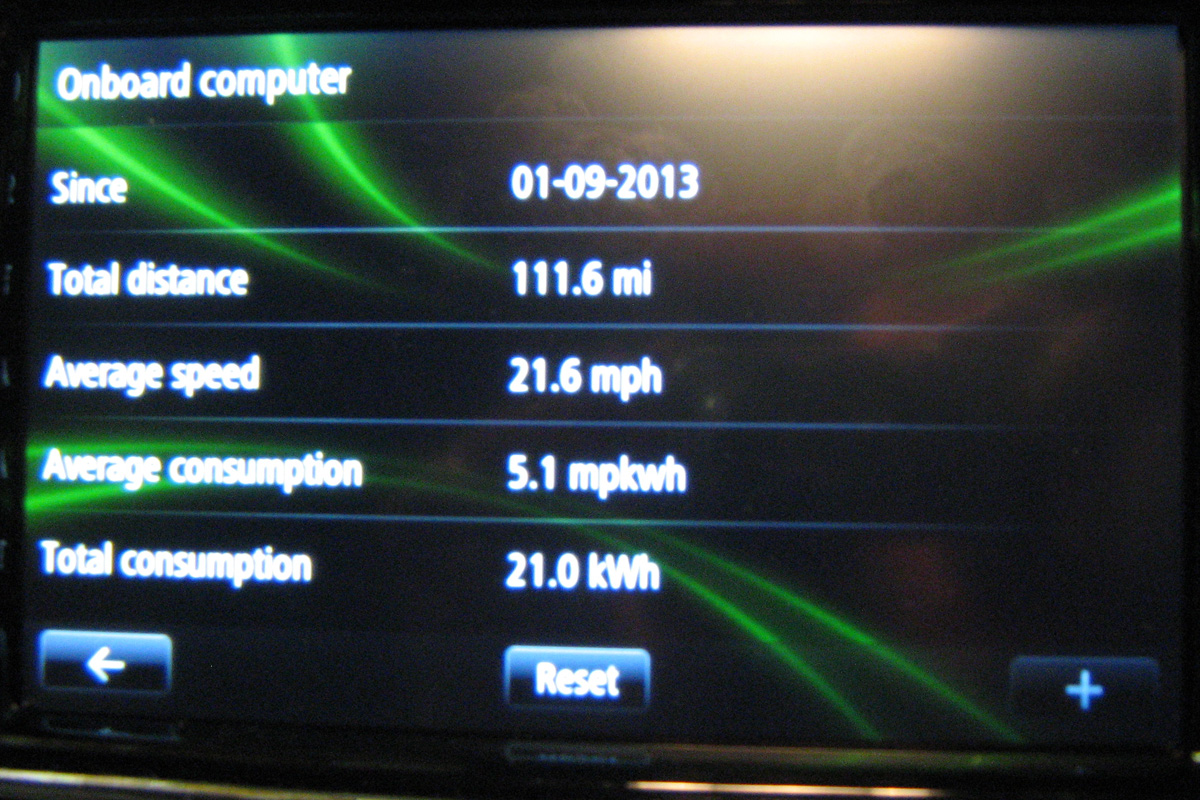
I continued to head home and – as I have found not for the first time – ZOE came up trumps and we got back without further incident. In fact, on looking through the logged data after the trip I found a readout on another screen (‘Onboard computer’) that showed ‘Total consumption’ as “21.0 kWh”, i.e. with a decimal point this time so in fact I probably had most of a kWh left and need not have panicked.

Onboard Computer display trip report (Image: T. Larkum)

Anyway, the experiment was a great success – I had achieved 111.6 miles (about 180km) of range and without trying too hard. Although towards the end of the second day I was deliberately driving slowly to maximise range, for most of the first day I had been much less gentle so there remains an opportunity to improve on this range value just by taking both days more carefully.

Furthermore, there were a number of things working against me that could be improved. The route to work was cross country, it has a lot of junctions and is also hilly – I could look for a flatter route. Also I made significant use of air conditioning and, after returning home the second evening, drove a long way using headlights – both of which would have eaten into the range. Finally, the tyres are looking a little flat after weeks of hot weather so could probably be much better inflated. If I try another ‘range record’ – and I am tempted to – I will address each of these issues.

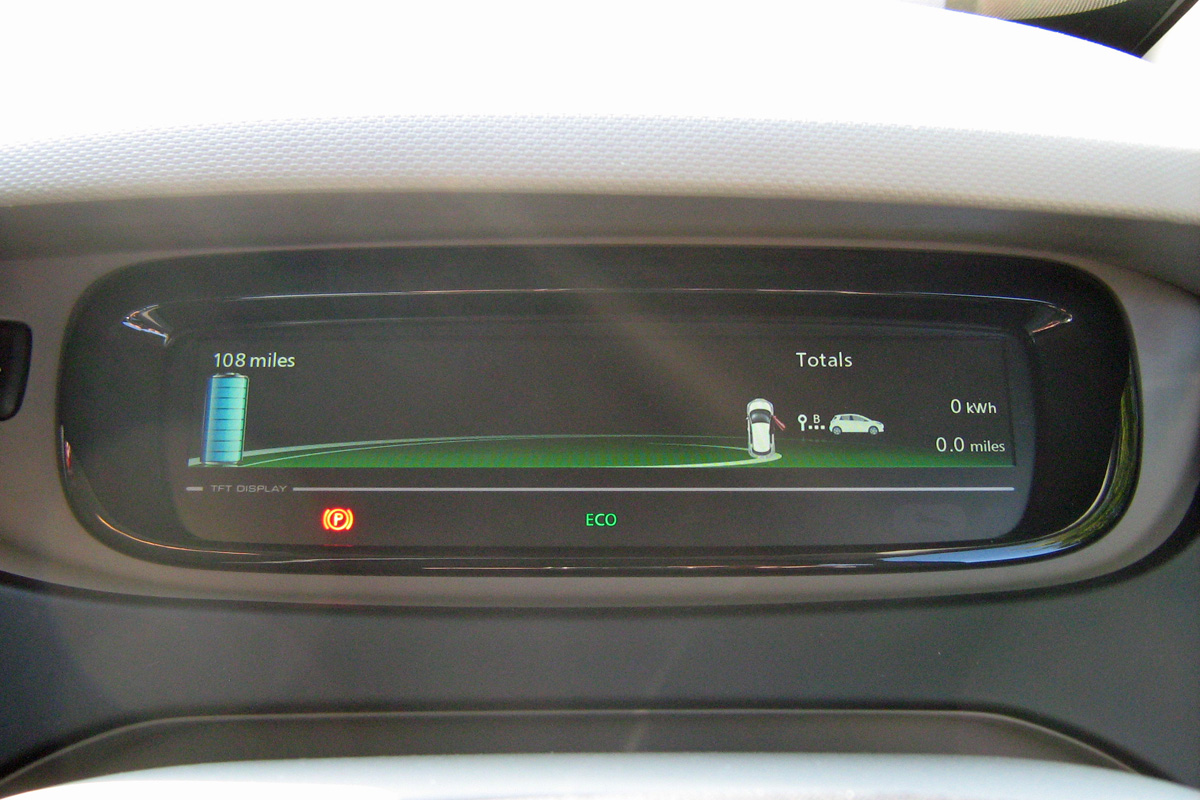
I charged the car overnight as usual (the virtually complete charge taking 3 hours 40 minutes). It was heartening to see this morning that the predicted range when I got in was 108 miles (in fact I also received an automated email in the early hours telling me the charge had completed ‘with an estimated driving distance of 110.6 mile’).

108 miles of range predicted when switched on this morning (Image: T. Larkum)

Of course, the first thing I did after a couple of days of restraint was to turn off Eco mode and enjoy driving the ZOE to work with a heavy right foot. I used up a big chunk of the range in short order, but I had fun!

SMMT News: Plug-in car registrations have risen 70% in UK over the first seven months of 2013

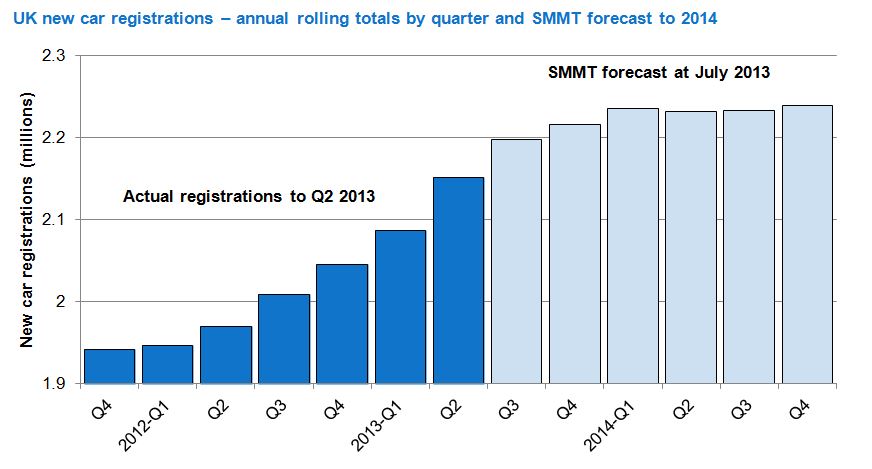
  • SMMT has significantly raised its forecast for 2013 new car registrations, predicting sales will reach 2.216 million units, 8.4% ahead of 2012.
  • Strong performance across the private, fleet and business market sectors saw the 17th successive monthly rise in July, growing 12.7% to 162,228 units.
  • Registrations of alternatively-fuelled vehicles grew 17.0% in the month to 2,432 and hit 17,859 units for the January to July period.
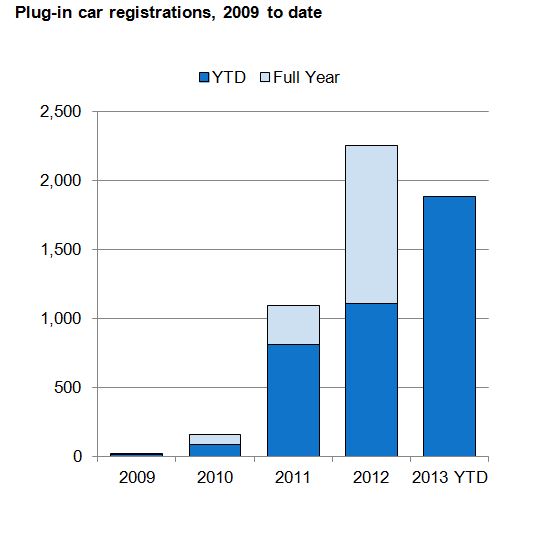
  • Plug-in car registrations have risen 70.7% over the first seven months of 2013, to 1,885 units.

Mike Baunton, SMMT Interim Chief Executive, said:

“Strong business and consumer confidence in July saw the new car market continue to rise, posting double-digit growth in the month. Now we have evidence of consistent growth, we have raised our forecast for 2013 new car registrations to 2.216 million units, an increase of over 8% on last year.”
“Recently, we’ve seen a range of economic indicators point to improving conditions and our raised sales forecast emphasises how positively we view the rest of 2013.”

  • Registrations of plug-in cars (pure electric and plug-in hybrids) over the first seven months of 2013 have risen 70.7% from 1,104 units a year ago to 1,885 units in 2013.
  • Already this year, registrations have exceeded 80% of 2012 full year volumes and are 11 times higher than 2010.
  • Growth reflects increased availability of products across the UK and wider interest from motorists looking to minimise CO2 emissions and take advantage of tax breaks.
  • More than 10,000 plug-in vehicle charging points have been installed across the country, with around half match-funded by government’s Plugged-In Places initiative.

Source: SMMT