
I am currently doing an educational course in climate change and as part of that I have conducted a project to calculate my family’s carbon footprint. Here I would like to pass on some of what I have learned about our energy carbon footprint, that part of our footprint resulting from domestic energy consumption and operating a car. Other aspects of a carbon footprint are just as important, related to what you buy, where you travel, what you eat, and so on, but unfortunately are much harder and less reliable to calculate.
For our energy footprint I have gone as far forward as June 2014 and as far back as 2008, the furthest year for which I have reliable energy consumption records. In all cases I have had to use estimates to fill in gaps in the available data. I am specifically looking at our household usage of natural gas and electricity, and my use of a car. Originally I did it per year but have since broken it down further into six month periods as this shows up changes in energy consumption, resulting from changes in lifestyle, more clearly.
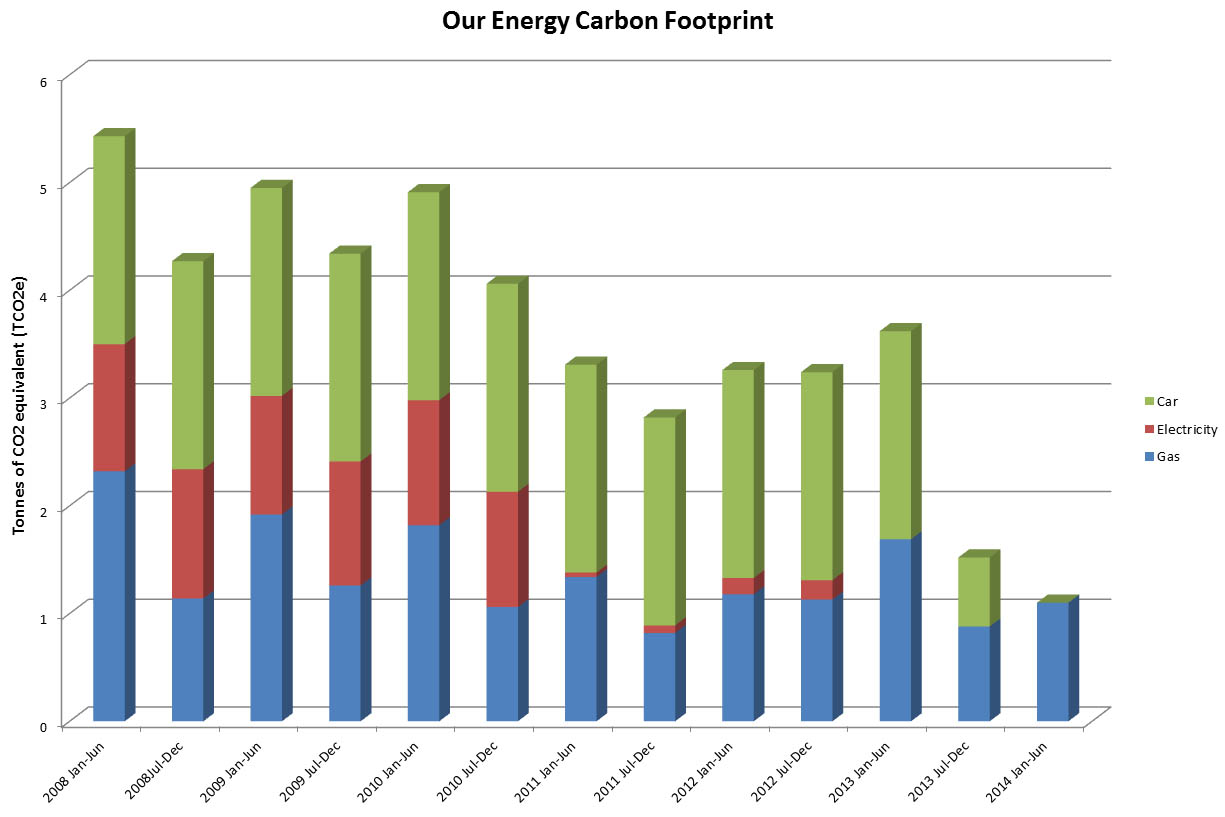
The basic chart can be seen in Figure 1 (with the carbon cost of each fuel calculated via CarbonFootprint.com). It can be seen over most of the period that gas, electricity and the car each contributed roughly one third to the overall footprint. There is also a tendency for the first six month period in each year to have a higher gas footprint than the second period, essentially due to the coldest months (January and February) falling in the first period.
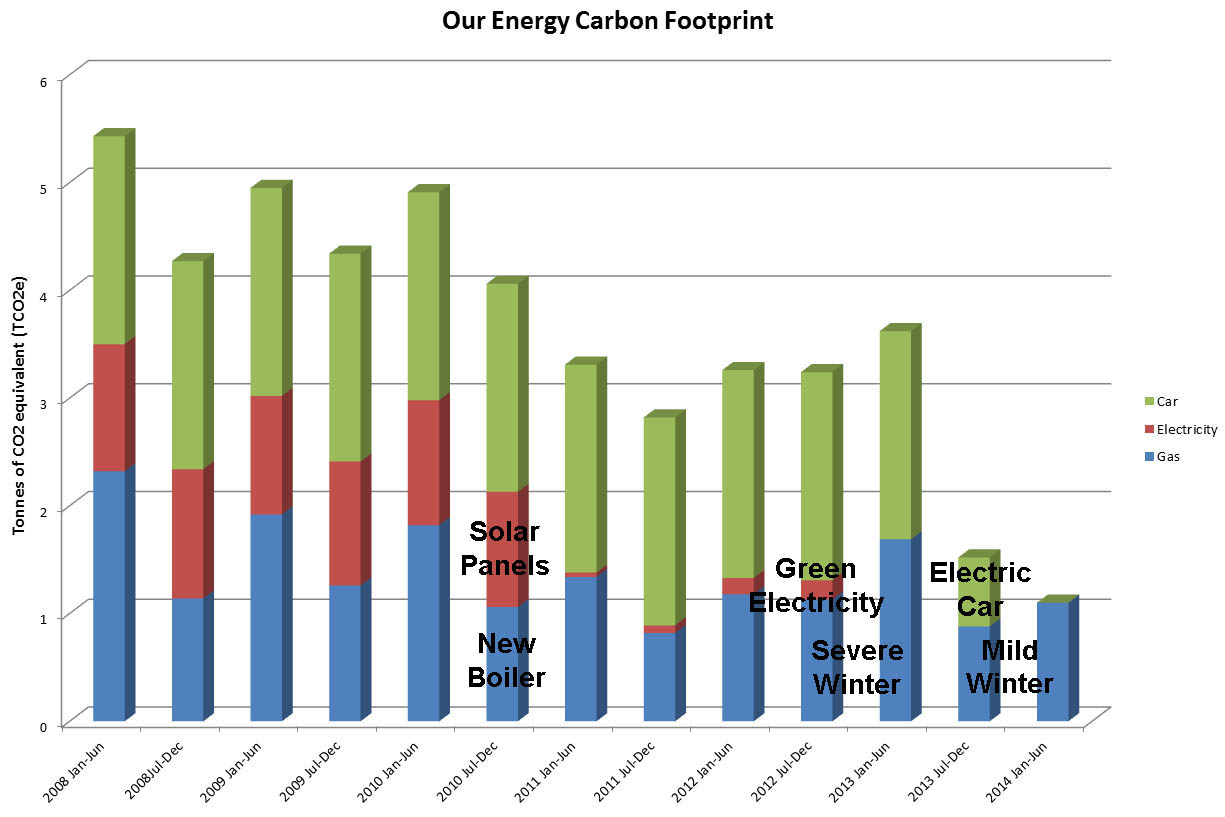
Now for some background on our lifestyle changes during this period. I began reducing our energy footprint in the summer of 2010. Firstly, I installed solar panels on our roof. At the time I was not considering our footprint; rather I did it as an investment, and because I liked the idea of ‘getting something for nothing’, which is a pretty good description of solar power. Secondly, we took advantage of a particular special offer from British Gas and had our old boiler replaced with a more efficient model.
It wasn’t until the start of 2012 that I started reading about global warming and started to get interested in (and concerned about) climate change. By 1st May I had ordered my Renault ZOE electric car, though it was to be more than a year before it was actually delivered.
So let’s now analyse the data in more detail and see what we can learn. These are the key elements as I see them:
- Gas: I believe there is a visible/detectable drop in typical gas usage after the summer of 2010 and that this is attributable to the more efficient boiler.
- Gas: Notwithstanding the change in boiler, the end 2012/early 2013 periods show particularly high gas usage because of the severe winter.
- Gas: The end 2013/early 2014 periods show low gas usage because of the mild winter.
- Electricity: There is a very clear drop in electricity usage after the end of 2010. This is due to the solar array since it generates nearly as much electricity as we use, and I am calculating the carbon footprint for the net electricity used over the period.
- Electricity: There is no electricity carbon footprint after the summer of 2013 as we changed over to a completely green/renewable electricity tariff (from Ecotricity).
- Car: I use my car for commuting to work so I did an approximately constant mileage over the period. For most of the time it was with a thirsty Vauxhall Zafira (giving about 32mpg), hence the high carbon footprint.
- Car: The Renault ZOE arrived in July 2013 so the second half of 2013 shows a reduced car footprint. 2014 onwards shows no car footprint – this is true whether it is considered either to be powered from entirely renewable energy, or from our excess of solar electricity.
The good news is clearly that we have managed in six years to reduce our energy carbon footprint from about 5 tonnes of CO2e (carbon dioxide equivalent) per 6 month period to about 1 tCO2e. However, there is clearly no case to justify us resting on our laurels:
- Our gas usage is still huge at about 2 tonnes CO2e per year. I can see no simple solution to this. In the short term we will likely start to use electricity to heat our hot water. Longer term we may need to move the house from gas central heating to electricity storage heaters or similar.
- As mentioned at the start, our energy footprint is just one part of our total footprint. Our core ‘secondary’ footprint is something like 6 tonnes (from food, shopping, entertainment, etc.). In addition, a typical family holiday to Spain would add another 2 tonnes. Significant changes here would require major lifestyle changes, like giving up holidays and becoming vegetarian.
So taken altogether, our 80% reduction in energy footprint is probably only a 30% reduction in our total carbon footprint – and yet it was the easiest part to reduce.