How and When Will Electric Cars Replace Fossil-Fuelled Cars? Part 1

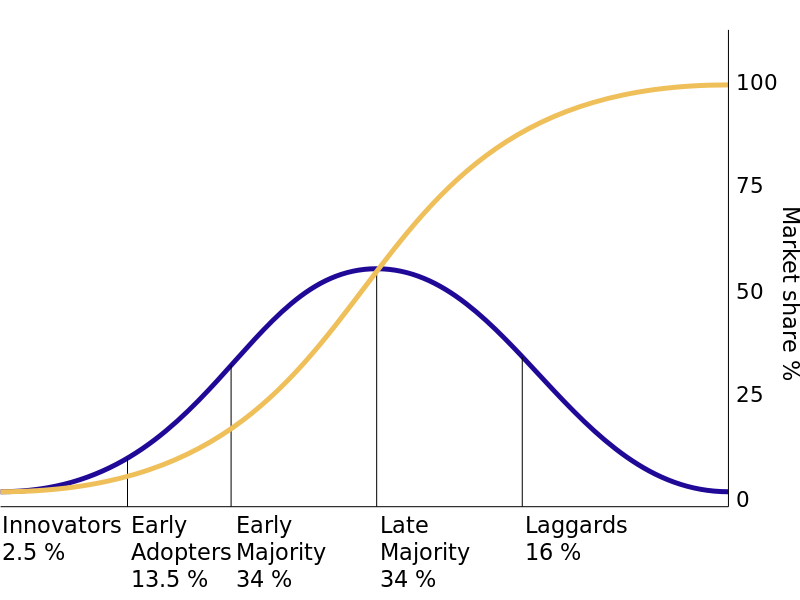
Figure 1: Diffusion of Innovations Curves (Image: Wikipedia)

Electric cars are here, now, and selling in increasing numbers. They are getting better and cheaper each year to the extent that they are typically only slightly more expensive to buy than a fossil-fuelled car, and yet they are much cheaper to run. EVs are quieter, smoother and have zero emissions, and increasingly have the performance and range to match fossil-fuelled car.

It is natural, therefore, for the question to arise as to whether, or when, electric cars will replace fossil-fuelled cars. A quick Google search will show up many opinions on this subject. EV drivers are often very optimistic and believe EVs will take over in just a few years (say, by 2020). In contrast, conservative organisations don’t just take an opposing view, they often seem to ignore recent developments and seem to be able to argue that EVs will never compete with conventional cars or sell in significant numbers, even though they are already doing so.

An interesting example of this doublethink is the U.S. Energy Information Administration’s ‘Annual Energy Outlook’ report for 2014. It is due to be released soon, but an early version of the report was released at the end of 2013. It includes the headline prediction that in the US Just One Car Out of 100 Will Be Electric in 2040. This despite the fact that US plug-in sales have already increased from 0.14% in 2011 and 0.37% in 2012 to 0.62% in 2013 (source: Wikipedia).

It seems that most analyses of future EV market share simply represent the opinion of the author. However, I believe it is actually possible to make a data-driven projection of future market share based on known market share data so far. Further, the adoption and growth in market share of innovative technologies (computers, mobile phones, tablets, etc.) is already well studied and I believe EVs will follow the same path.

Specifically I posit that EVs will follow the standard diffusion of innovations approach, which is a theory that explains how, why, and at what rate new ideas and technology spread through cultures. A key element is that adoption begins with a small subset of buyers, the Innovators, then passes through other categories of consume to achieve full adoption (the other categories are Early Adopters, Early Majority, Late Majority, and Laggards).

The rate of change of market share follows a ‘bell curve’ with adoption being very slow at the start, then increasing significantly, then levelling off at 50% market share, before falling away as it takes over the remaining market – this is the blue curve shown in Figure 1. It is interesting to note that within the rate of adoption there is a point at which an innovation reaches critical mass – this is a point in time when the number of individual adopters ensures that continued adoption of the innovation is self-sustaining.

If we consider the percentage of market share over time then this follows an S-curve, with very low market share expected at the start. This starts to accelerate as the majority groups adopt the innovation, then it slows down again as the market approaches saturation – this is the yellow curve shown in Figure 1.

The adoption of electric cars is currently still in the almost flat starting part of this curve. In the next part I will show how we can apply the data we have on EV market share so far to this adoption curve to predict future adoption rates and market share for EVs, and calculate the likely timescale until EVs dominate the car market.

[Part 2]
Home › Forums › How and When Will Electric Cars Replace Fossil-Fuelled Cars? Part 1

This topic contains 12 replies, has 3 voices, and was last updated by  donald 12 years, 7 months ago.

Viewing 3 posts - 11 through 13 (of 13 total)
  • Author
    Posts
  • #8216

    Trevor Larkum
    Keymaster

    Donald – good points as ever. With regard to motorway charging, I see a halfway house. Essentially, I think our services could look a lot like they do at the moment – but every parking space will have a charger. Each car will have the option of charging, if it needs it, during the time the driver is in the services going to the loo, getting a meal, etc.

    With regard to electricity consumption, I haven’t checked your figures – I’m sure you’re right. But it ignores the massive gains we would make by not refining fossil fuels. I have read that a western nation uses something like 30% of its total energy consumption on fossil fuel support, particularly refining. I’m sure you’ve heard too that an EV can drive something like 100 miles on the energy it takes just to get a conventional car’s fuel from the ground to the pump.

    #8218

    donald
    Participant

    I haven’t checked your figures…it ignores the massive gains we would make by not refining fossil fuels. …I’m sure you’ve heard too that an EV can drive something like 100 miles on the energy it takes just to get a conventional car’s fuel from the ground to the pump.

    Good point, though I am not quite sure the impact that has on the particular calculations I made, as I’m only presuming to discuss extra expansion of electricity delivery for EVs from non-fossil fuels.

    Not sure what the relative energy overhead is to shift oil from well to wheel, I would have to go look it up. Clearly the overhead losses get bigger over time too as the field become more marginal, whereas we can hope to imagine that ‘cleaning up’ the electricity generation will be the opposite and only get better.

    services could look a lot like they do at the moment – but every parking space will have a charger

    That’s how I tend to see it in the future too. I can’t really see much of an alternative, if it is going to happen at all. But my picture has only (or ‘mainly’) inductive chargers. Each parking spot will have a little mound, but that is all and otherwise are usable by any cars.

    [Unfortunately, my vision of en-route inductive charging is a pipe-dream seeing as Highways Agency can’t even keep the motorways from failing into deep potholes, so any hope for something more technically complex is unimaginable on any time-scale right now.]

    Plug-in or inductive, you also have the question over total power delivery to a large charging site. If each charging point is a 50kW station and you have, just for illustration, 200 cars charging at once, then the site needs 10MW power delivery. That’d be 3 wind turbines running, or 100 acres of solar panels. My preference would be for a small modular buried nuclear power source, which is a concept rapidly gaining technical credibility albeit lacking political interest!

    #8220

    donald
    Participant

    So, based on what I have found;

    http://www.eia.gov/dnav/pet/pet_pnp_capfuel_dcu_nus_a.htm
    &
    http://www.eia.gov/dnav/pet/pet_pnp_capprod_dcu_nus_a.htm

    it would seem to me that each gallon (imperial duly converted) is matched by the consumption of 3kWh, so about 10 EV miles.

    Other studies show that about 6 kWh of energy is needed for each US gal of refined road fuel. However, there will be a mix of energy sources, some from the fuel itself. 3 kWh of electricity seems reasonable, in that context.

    The figure of merit is not transparent because refining consumes many other forms of energy inputs, and has many varied product outputs. I think it is therefore a ‘reasonable’ 1st approximation to simply match the electricity inputs with the road fuel outputs.

    So if we assume 40mpg as a whole fleet average (?guesstimate?) and save 10 EV miles for every ICE gallon we displace, then we reduce the electricity ‘burden’ by a quarter. So I think that means my 120 TWh estimate for annual EV electricity demand reduces to 90 TWh.

Viewing 3 posts - 11 through 13 (of 13 total)

You must be logged in to reply to this topic.