EV Spotting

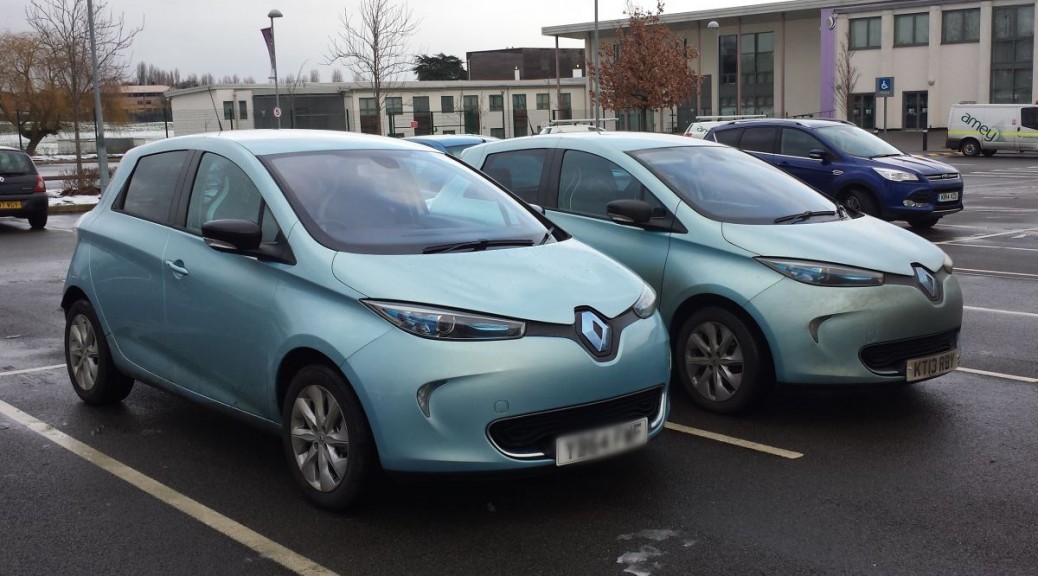
ZOE Twins (Image: T. Larkum)

It turns out my Renault ZOE is no longer the only one in my local area, around Northampton. An almost identical but newer Dynamique Intens has turned up, and I’ve seen it in Northampton and nearby Wellingborough. It’s even the same Energy Blue colour. I’m embarrassed to say I can always tell which one is mine, it’s the dirtiest one!

Catching a quick charge at the local Renault dealer (Image: T. Larkum)

While catching a charge recently at the Renault dealership in Bletchley I spotted a ZOE with the rather neat registration number of “EV13 ZOE” (where, of course, EV is ‘Electric Vehicle’).

ZOE with custom number plate (Image: T. Larkum)

Meanwhile I saw the first BMW i3 in my home town of Northampton recently. It was just sitting outside the local shopping centre/health centre looking entirely at home. For sure it will be the first of many.

The first BMW i3 spotted in Northampton (Image: T. Larkum)

Source: Fuel Included Blog

Next-Generation Renault ZOE With Real-World Range Of 186 Miles

Interesting and potentially huge news is coming out of France in regards to the new, next generation Renault ZOE and next-gen Nissan LEAF.

According to Les Echos, the new versions of both models will be ready in 2017 with double the range of today’s Renault-Nissan electric cars.

In the case of the next-gen ZOE, Beatrice Foucher, Director of Renault’s electric program, stated that the aim is 300 km (186 miles) of real-world range (and 400 km stated on NEDC).

The current generation of ZOE can go 210 km (130 miles) in NEDC testing.

Nissan apparently could equip the new LEAF with a 48-kWh battery pack, according to the report out of France.

Les Echos sees progress in battery technology, as well as in falling prices per kWh – from $1,000 in 2010 to $400 in 2014 and $180 in 2025 (forecast).

Source: Inside EVs via Fuel Included News

The Electric Vehicle: Celebrating Five Years of Progress

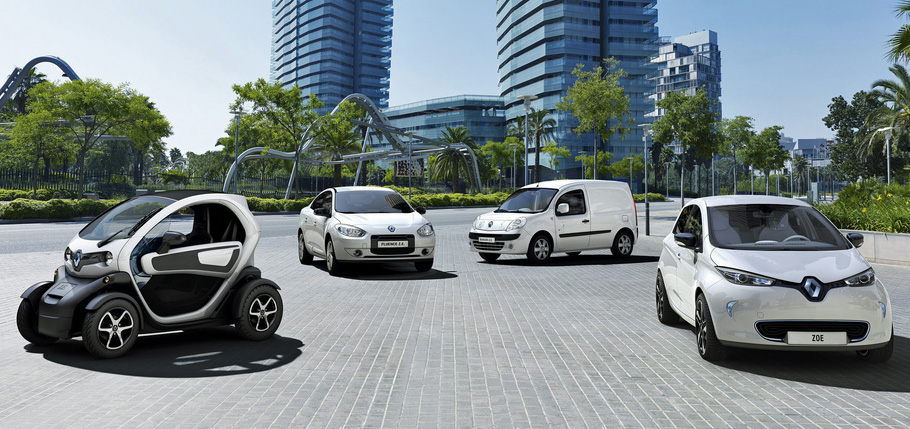
Towards the end of 2009, zero-emission electric cars were little more than concept cars. At that year’s Frankfurt motor show Renault displayed four electric prototypes – the Fluence, Z.E sedan, the Kangoo Z.E van, the Twizy tandem two-seater and the ZOE subcompact… but that’s all they were: ideas. Electric cars were an utopian dream, something for the sci-fi magazines.

What a difference five years makes. Today electric cars are a reality. Manufacturers, led by Alliance partners Renault and Nissan, have a growing number of pure electric vehicles on sale – indeed, the trail-blazing Nissan LEAF is the world’s bestselling EV.

Major cities across the globe all have extensive recharging posts in place, and extended fast charging networks now link countries. Electric bikes and scooters are readily available and Renault is behind a global single-seat motor racing championship purely for electric vehicles – Formula E.

Cities and towns in France – 18 in all, including Paris, Lyon and Bordeaux – have car-sharing programmes, called Autolib, based around electric vehicles. EVs have caught on in London, too, where the electric Nissan e-NV200 has been developed into an iconic black cab and is due to start taking fares next year.

So what’s going to happen between now and 2020? There can be no doubt that charging networks will continue to expand and sales of EVs will rise and rise. And, who knows, electric vehicles might no longer need humans behind the wheels. Autonomous cars might be at the concept stage at the moment… but as we have seen, a great deal can happen in five years.

Source: Renault-Nissan Blog via Fuel Included News