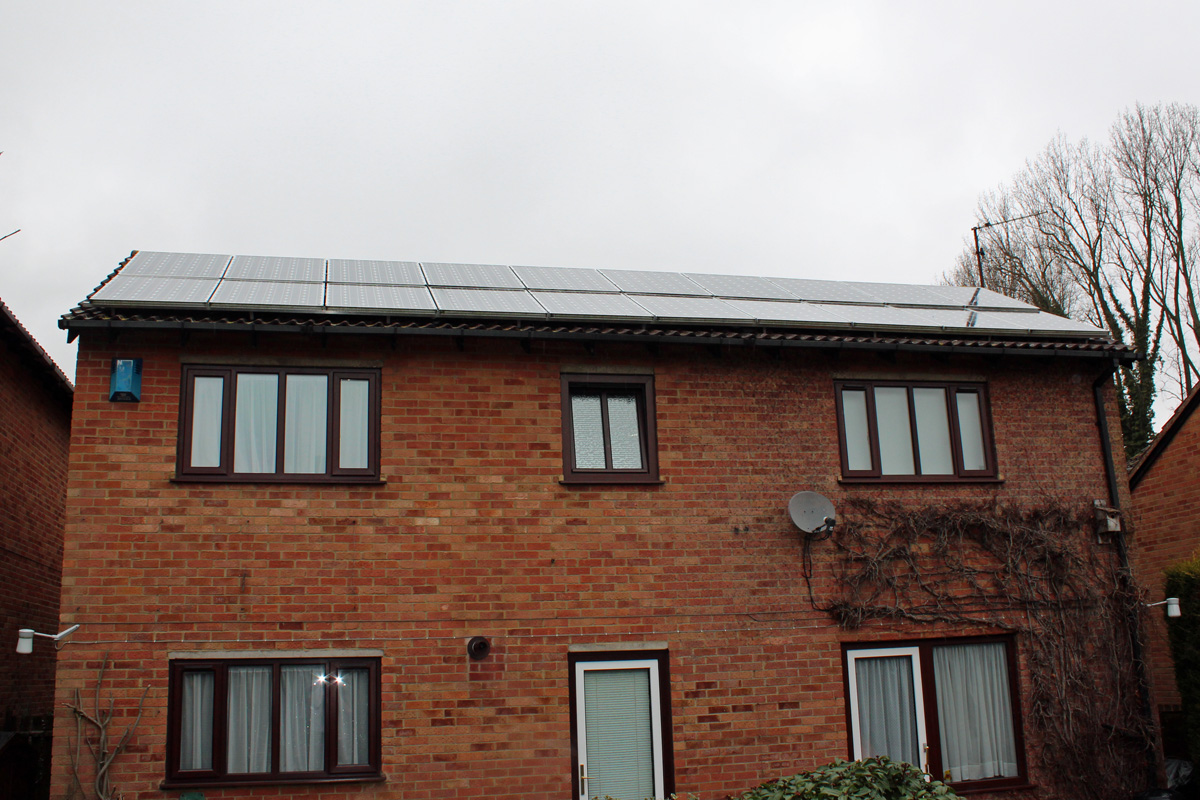
Solar Panels Completely Covering the Back Roof (Image: T. Larkum)
I described previously the installing of our solar panel system in The Joy of Solar 1: Installation but to complete the story it is necessary to describe the remainder of the system, most of which is internal to the house.
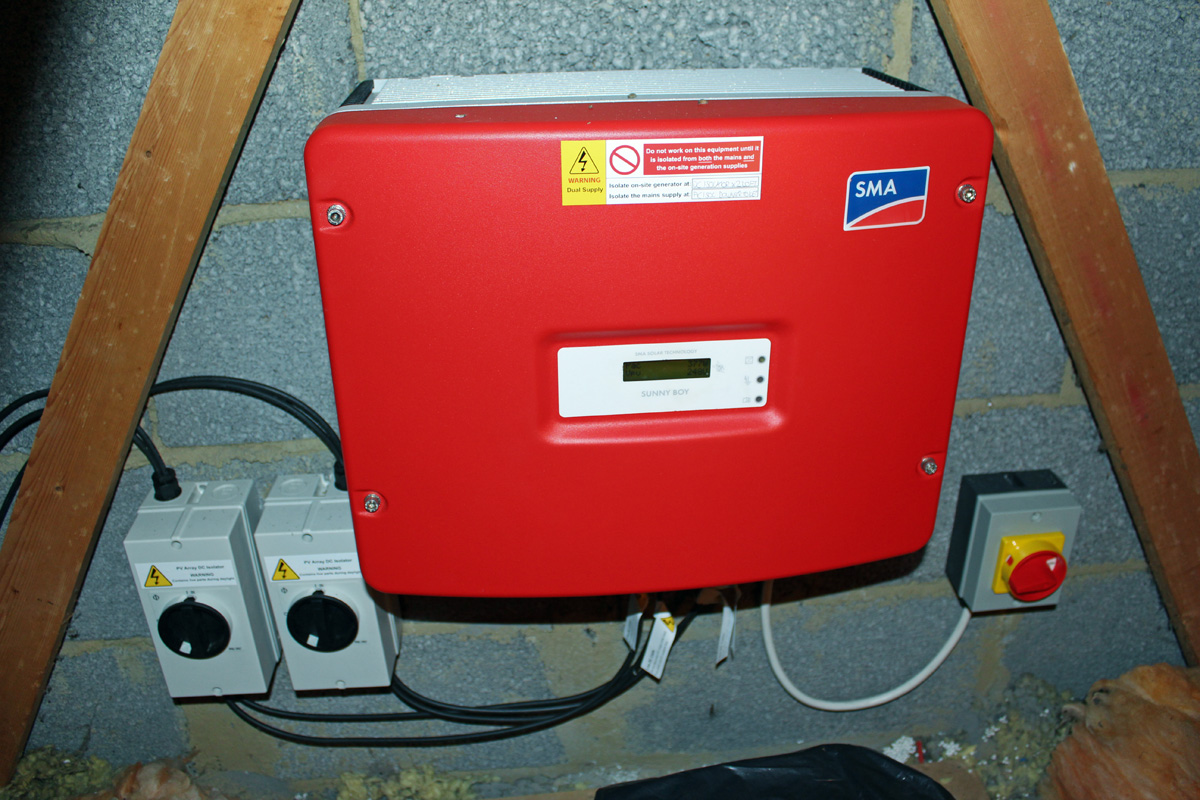
The panels on the roof produce low voltage direct current (DC) that needs to be converted to domestic voltage alternating current (230V AC) before connecting to the house electrics and national grid. In our case the wiring from the panel goes into the loft space to a large, red SMA ‘Sunny Boy’ inverter fitted on the inside of the end wall, and it’s this inverter that does the conversion. There are also three isolators; two can switch off the power from the panels before it goes into the inverter, and another can switch off the power from the inverter before it leaves the loft.
Left to Right: Panel Isolators, Inverter, and Inverter Isolator (Image: T. Larkum)
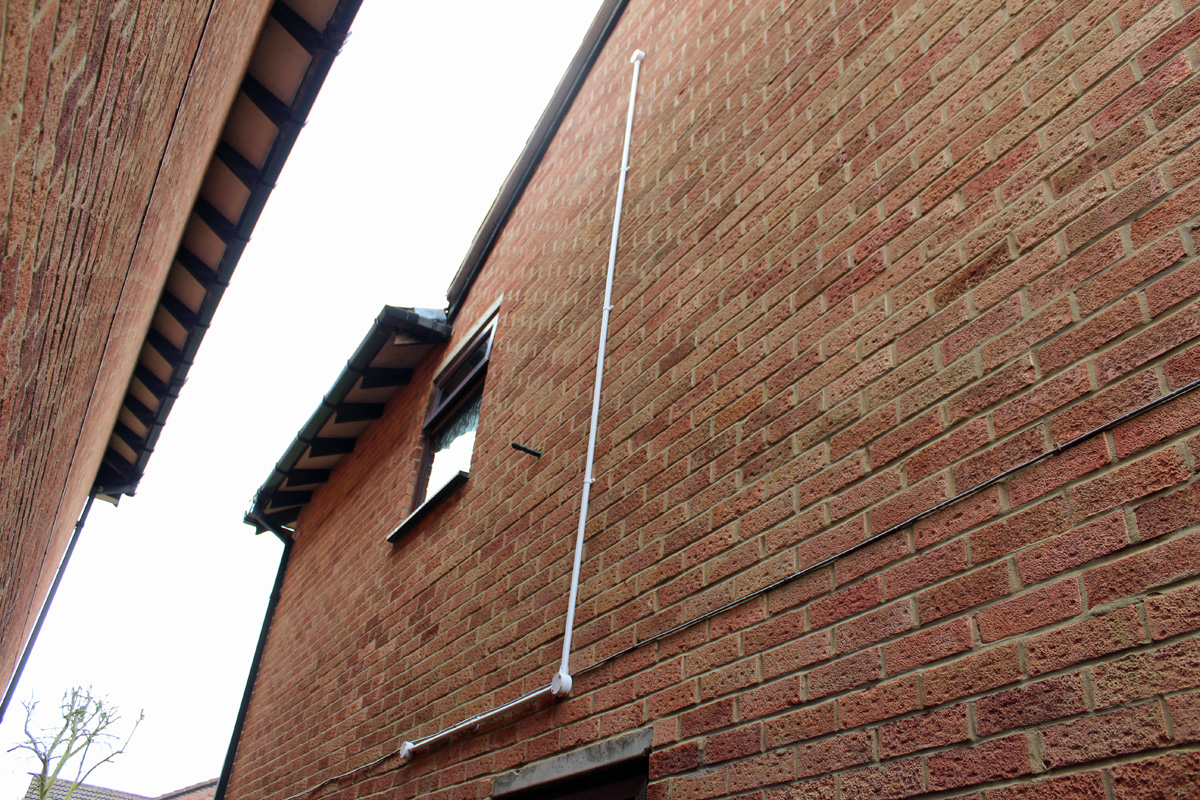
The cable from the inverter isolator then runs down the outside of the end wall and back in on the ground floor.
Power Connection from Inverter to Consumer Unit (Image: T. Larkum)
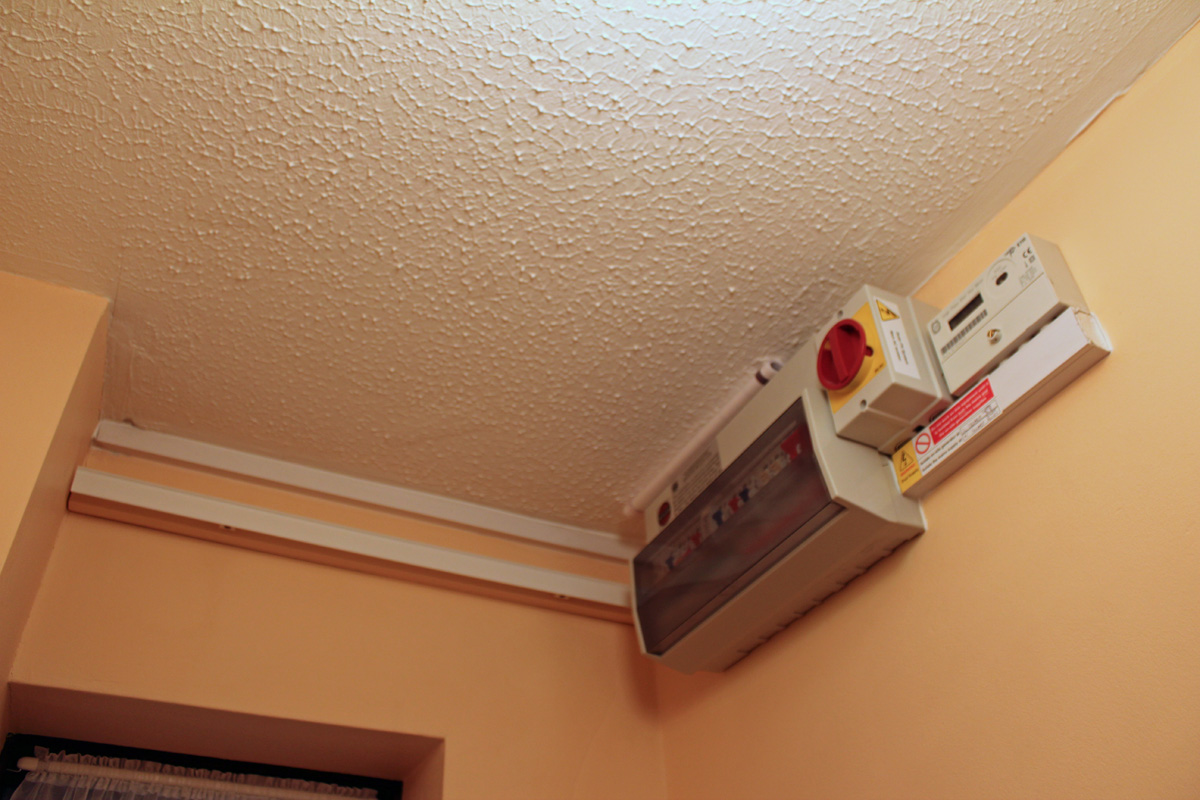
Inside it travels a short distance to another isolator, through a small generation meter, and then into the existing home consumer unit (with RCD).
Left to Right: Incoming Cable (in conduit), Consumer Unit, Isolator and Meter (Image: T. Larkum)
The work has been done very neatly – my only complaint is that the meter is set very high up, meaning I often have to stand on something to read the solar meter. Of course, technically I only need to read it once every three months to claim the feed-in-tariff payment, so it’s my fault I’m often in there checking it and – whenever the sun comes out – just watching the meter tick up!
I’ll write up full details on how the whole solar system has fared in later posts – costs, power details, generation rates, etc. Suffice to say that, in two and a half years, it has generated more than 7,800 kWh of electricity, for which we’re being paid about 44p per kWh (so about £3400 so far). Using a typical value of 0.525kg CO2 per kWh for the UK national grid that means it has already saved four tonnes of climate changing carbon dioxide.
The Zoe has received or been nominated for more than its fair share of awards, mostly related to its environmental potential.
It was recently reported that it had received the ‘Oxygen Award’ in the category ‘mobility and air quality’ at ‘Les Respirations’. This is an annual conference on how the atmosphere, climate and ecosystems can be protected and the opportunities to breathe clean air in cities, at work and on the road. The award was granted not just for the Zoe’s zero emission ability, but also because of its advanced air filtration and ‘Zen’ aromatherapy system.
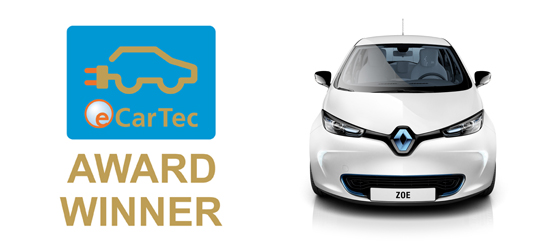
In October last year Renault received two of the prestigious eCarTec awards for electric mobility, one for the Zoe and another for its Zero Emission strategy. This took place on 23 October at the 4th International eCarTec trade fair for electric and hybrid mobility on the grounds of Messe München. Over 60 international companies and institutions had applied for the competition in eight categories.
Currently Zoe is a finalist for the 2013 World Car Awards in the 2013 World Green Car category. The winner will be announced at a press conference hosted by the New York International Auto Show and Bridgestone Corporation on Thursday, March 28.
[This release has been edited to focus on the electric Kangoo ZE]
1st February 2013
RENAULT UNVEILS FACELIFTED KANGOO VAN
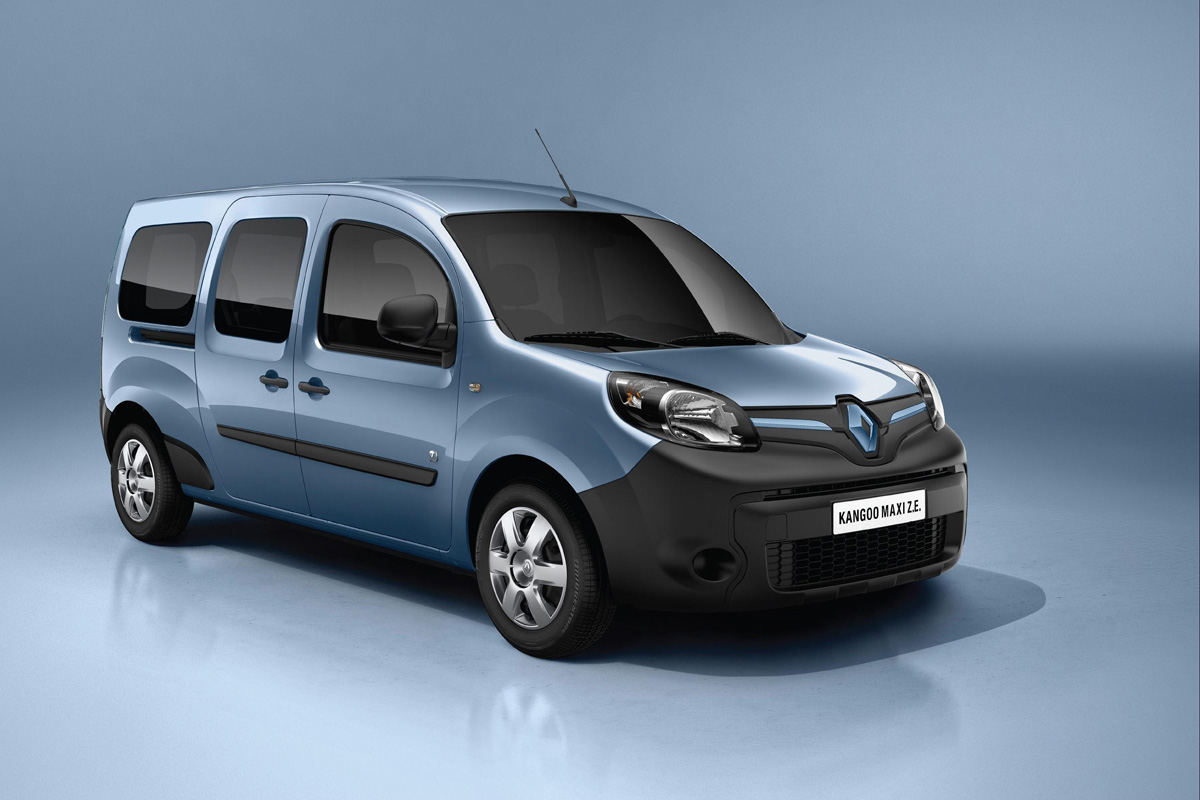
Kangoo Van Maxi Z.E.
The New Year sees Renault, Europe’s number one van manufacturer; renew its compact van line-up (Kangoo Van was the best-selling model in its class in 2012, with a market share of 17.4 per cent). Significant changes have been made to Kangoo Van, which now features Renault’s new styling identity, following the introduction of a new front bumper. In the cabin, the dashboard has been revised in order to heighten the impression of quality.
Kangoo Van Z.E. is even more clearly identifiable as an electric vehicle. Europe’s leading electric van comes with a new specific front bumper which incorporates the flap for the battery charger behind the bigger, blue-tinted, more vertically-positioned logo.
The new Kangoo line-up features best-in- class engines for fuel efficiency. The dCi 75 and dCi 90 diesel engines are available with Stop&Start.
New equipment includes ESC with Hill Start Assist and Grip Xtend, plus, the connected in-dash Renault R-Link multimedia system.
Renault’s range of small vans is made exclusively at the firm’s MCA de Maubeuge plant in France.
Since its launch in 2008, the second-generation Kangoo Van has already found favour with more than 400,000 business customers. Renault’s compact van, which tops the European market, returns in strength this year with the release of a brand new Phase 2 version which covers the entire range, from Kangoo Van, and Kangoo Maxi, to Kangoo Van Z.E. and Kangoo Maxi Z.E.
The changes are immediately apparent, including the introduction of a new front end which incorporates the styling cues of Renault’s new design language, with a more prominent, vertically positioned logo. The new design highlights its robustness and modernity.
New door mirrors and headlights blend more harmoniously with the vehicle’s overall lines and the cabin, too, benefits from a new design in the form of a superior quality centre console and new steering wheel.
New Kangoo Van range
The Kangoo Van range offers two wheelbase lengths, three versions of the popular 1.5-litre dCi diesel engine (75, 90 and 110hp) and a choice of two- or five-seat versions of the Kangoo Maxi. The five seat “Crew” version features a rear seat that can be tipped forward to accommodate particularly long loads.
An impression of quality that expresses New Kangoo’s inherent robustness
During the development of New Kangoo Van, significant attention was paid to improving the impression of quality. A thorough review process lasting several months was implemented with a view to identifying those areas which permit the van’s strength to be instantly recognisable. The areas to benefit from attention include:
– Spot weld finishes,
– Crimping quality of door panels (cleaner, more consistent finish),
Innovative equipment: Renault R-Link, ESC with Hill Start Assist and Grip Xtend
New Kangoo Van benefits from a connected multimedia system thanks to the introduction of R-Link (optional, or standard equipment for ‘Sport’ versions). This system incorporates the in-dash TomTom® LIVE navigation previously available for Phase 1 Kangoo, plus numerous new functions, such as advance warning of hazardous zones and the ability to download applications like the reading out of e-mails. The range of radios has evolved, too, with a choice of three solutions. All radios come with USB and Bluetooth connectivity, while the next level up is equipped with a CD player. The premium radio integrates with the Renault R-Link system.
Also available is new-generation ESC combined with Hill Start Assist, plus Grip for improved traction in difficult conditions. It goes without saying that New Kangoo Van continues to be available with the many innovations that have forged its reputation, including the sliding rear roof flap.
New Kangoo: made exclusively at Renault’s Maubeuge plant
All New Kangoos will be made exclusively at Renault’s MCA de Maubeuge facilities in France. This factory is notably acclaimed for its ability to cover a wide range of vehicles and options (63 versions of Kangoo, 21 engines/motors, the Mercedes Citan, 200 colours), as well as for its uncompromising quality inspection procedures. The factory has made more than 4.9 million vehicles since 1971, including almost three million small vans and ludospace derivatives.
The Maubeuge plant also houses a Renault Tech facility. Kangoo Vans can consequently be converted on site as they come off the line, allowing business customers to take delivery of quality, tailor-built vehicles directly.
A more assertive ‘electric’ look for Kangoo Van Z.E., Europe’s number one compact electric van
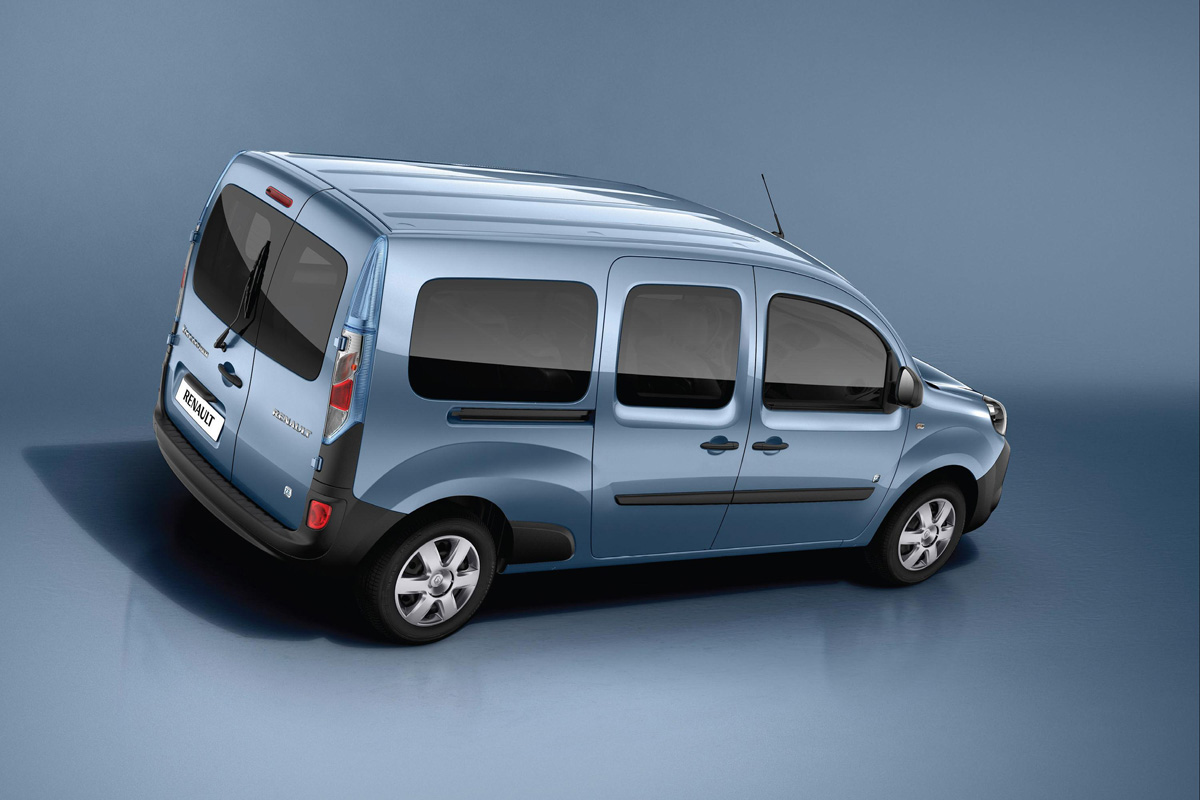
Kangoo Van Maxi Z.E.
Like the whole Kangoo Van range, New Kangoo Van Z.E. comes with a new front end which features the brand’s latest styling identity. The differences between the electric and internal combustion-engined versions have been accentuated. New Kangoo Van Z.E. comes with a blue-tinted logo, for instance, and blue rear light trim extensions, as well as new black headlight masks.
The socket for New Kangoo Van Z.E.’s battery charger is now located behind the logo, at the front. By plugging in the cable provided, owners can benefit from a complete charge in between six and nine hours using a Wall Box at their home or at a roadside charging station.
Another specific feature is the Z.E. Voice function which emits a sound to warn pedestrians of the vehicle’s approach. This system is activated at speeds of between 1 and 19mph (no sound at a standstill). Meanwhile, in order to benefit from off-peak electricity rates, owners can programme the charging of New Kangoo Van Z.E.’s battery remotely using their computer or smartphone thanks to the ‘My Z.E. inter@ctive’ pack.
Unanimously acclaimed by the media, New Kangoo Van Z.E. has secured a long list of awards – including “International Van of the Year 2011”. It has also been endorsed by its early customers who have been swift to praise its driveability and battery charging capacity. The model stands out as Europe’s best-selling electric LCV with almost 7,000 vehicles sold to date, including 4,000 in France.
Your one stop source for news and updates on the Renault ZOE. For the latest prices and deals with free charging visit FuelIncluded.com.