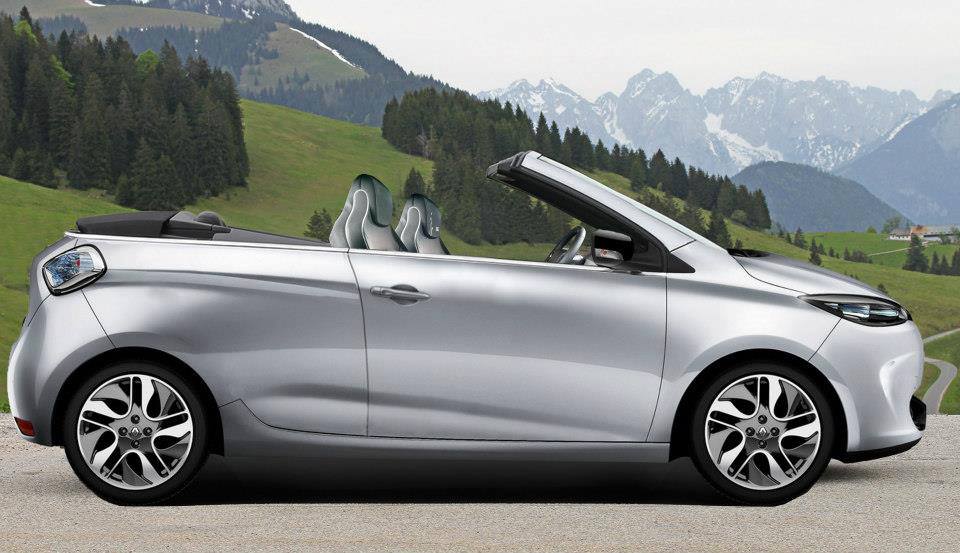
“Renault ZOE cabriolet: ideal for driving in the fresh spring air! Would you like this concept made by a fan to be real?”
The image is believed to have been produced by the creator of the Spanish Facebook community page Renault Zoe. It has generated a lot of interest and discussion, but there is no suggestion that Renault has any plans to build a ZOE Cabriolet.
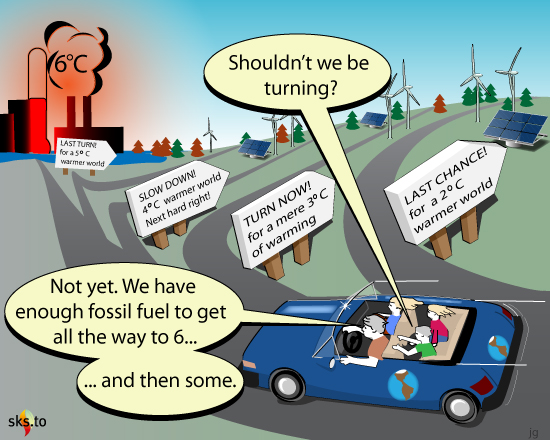
Forks in the Road: Last Exit to Two Degrees (Image: J. Garrett)
The road we are on leads to a climate hotter than any humans have yet endured. Only by cutting carbon emissions can we steer toward a stable climate. Each day that we don’t choose the path of reduced carbon emissions we cut off a possible climate endpoint. And the longer we delay turning down the path carbon-free energy the sharper and more difficult the turn will be.
The past year has seen some impressive debuts on the new car scene, and Diesel Car magazine is very proud to announce the winners of its much coveted and well respected annual Car of the Year Awards 2013. Our award winning writers have put every single new car through its paces, in a stringent test programme, to decide upon the very best cars in ten different segments. From a shortlist of 26 cars, our expert judges have come up with the class winners.
Class: Best Alternative Fuel Car
Electric finalist: RENAULT ZOE
Renault is proving to be quite a champion of electric cars, and the Zoe is its fourth EV and the most convincing one yet.
It is also the most instinctively appealing battery model so far.
With its trim little supermini looks, Clio underpinnings and roomy practicality, the Renault makes a strong case for going electric, with a 130-mile range and a similar price to a diesel Clio to boot.
Any anxiety about battery life longevity is overcome by a lease plan, and Renault will replace the pack for free when efficiency drops below 75 per cent.
Good to drive and blissfully quiet, the Zoe is a peach.
Hybrid finalist: MERCEDES-BENZ E-CLASS
Driving a hybrid should not be a quirky choice, as you want it to be utterly seamless and entirely unobtrusive, and that is what is so impressive about the E300 BlueTec Hybrid…
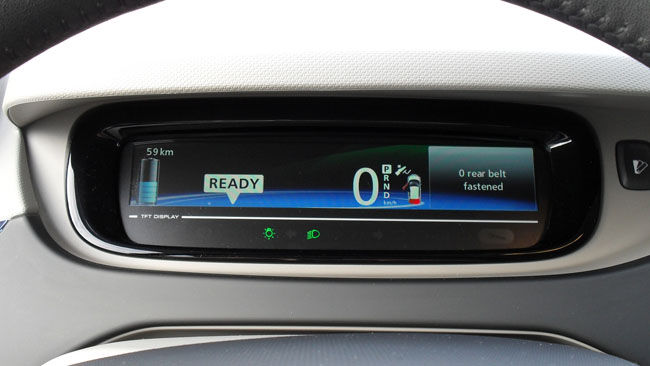
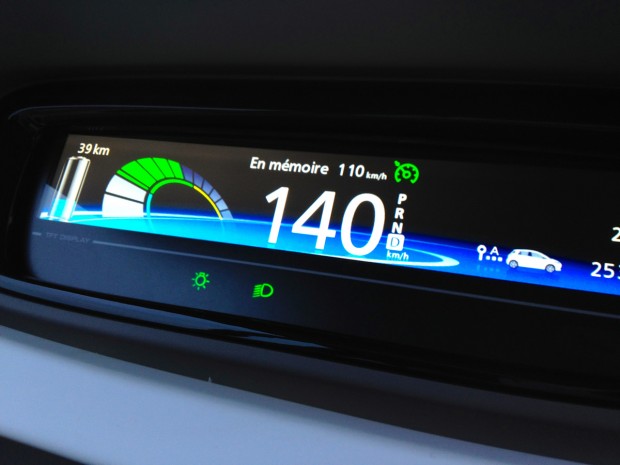
During the test drive I had a chance for the first time to try out some of the driver’s controls. First of all there is a display selector, just to the left of the main dashboard TFT display screen. This cycles between three different forms of display – as I recall one that’s primarily a numeric display of speed, energy consumption, mileage and so on; one that’s like a speedometer dial going up and down as electricity is used or generated, and one that has a more artistic display showing lines of energy moving to the right, from battery to car, when accelerating or moving to the left, from car to battery, when regenerative braking.
ZOE Display, ‘speedometer’ version (Image: MyElifeNow)
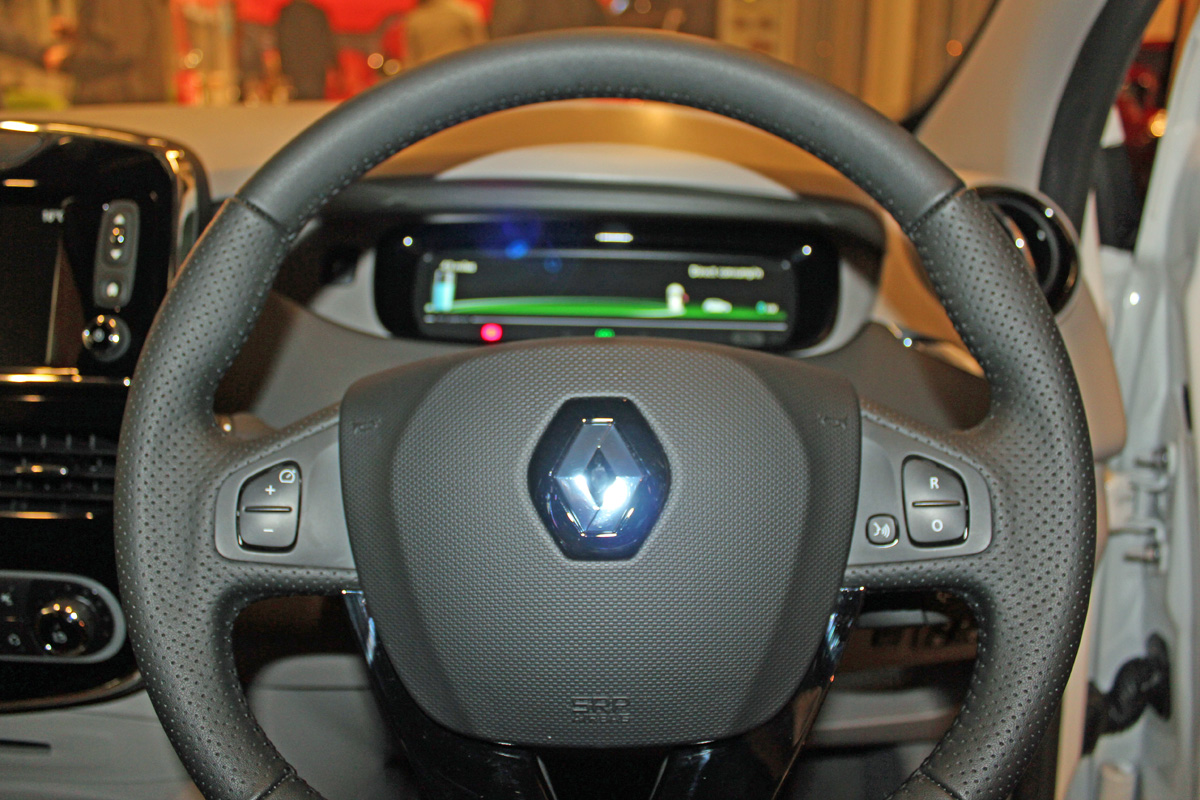
Next I tried out the cruise control. I believe this is initiated by the button to the left of the gear lever (it was actually done by the salesman) but then I was able to operate it using buttons on the steering wheel. When switched on the vehicle will accelerate or decelerate to the currently set speed; this speed is shown top centre on the driver’s display. The set speed can be adjusted up and down by a centre-biased switch on the left side of the steering wheel – pushing the top half of the switch (marked ‘+’) increases the set speed and pushing the bottom half (marked ‘–’) decreases the set speed.
Cruise control buttons on steering wheel (Image: T. Larkum)
The cruise control was certainly a novelty to me, perhaps because I’ve never driven a car before that had it. It was mildly disconcerting having it speed up or slow down apparently under its own control, though I can certainly see the attraction and use of such a system, particularly on the motorway. Pressing the accelerator or brake disabled it.
The cruise control can be engaged or disengaged by pressing the centre-biased switch on the right side of the steering wheel – pushing the bottom half of the switch (marked ‘O’) turns it off and pressing the top half (marked ‘R’) re-engages it.
The other button on the right of the steering wheel is to turn on voice-activated commands. I didn’t get a chance to experiment with it beyond pressing it and having the R-Link respond ‘Say voice command’ or something similar.
I certainly had the impression from my test drive that the ZOE is loaded with technology and clever controls, and look forward to experimenting with mine when it arrives.
For my test drive I had the opportunity to take a long drive out of the town and through the local countryside and so I was able to try out the ZOE in a variety of conditions. The experience of starting up is disconcerting, as is often said when someone used to a combustion engine tries an electric vehicle. You put your foot on the brake and then press the Start/Stop button on the dashboard. At that point the dashboard lights up but of course there is no engine noise – to someone used to a combustion engine it lacks the obvious feedback of a revving engine, though I imagine one could get used to it quickly enough.
To move you engage the gear lever (marked P R N D) from park to reverse or drive. Having always driven cars with manual gearboxes I really don’t like this lever. It seems to be to be a simple sop to those used to driving with an automatic gearbox. Since the ZOE has no gearbox I believe it would be far preferable to dispense with a gear lever altogether and have simple selector buttons on the centre console, or even a simple selector lever on the steering wheel like a sports or racing car. Similarly, as soon as you release the brake pedal there is ‘creep’ and the car starts to move – this makes no sense in an electric car and again, I believe, just panders to those used to automatics.
When starting off and moving at slow speeds it would be fair to describe the travel as ‘silent’. While technically not actually silent the quietness is eerie. There is no detectible sound from the electric motor, and the noise from the tyres is little more than you would get from someone walking past.
At slow speeds the brakes are noticeably ‘grabby’ – this was commented on by each driver. This is presumably because at low speed the friction brakes are being used exclusively. This may have been particularly noticeable on our demonstrator vehicle as it had such a low mileage and the friction brakes may not have been bedded in – it’s possible we would have noticed the same effect on a brand new Clio. At highway speeds the brakes are mostly using regeneration and felt fine – very smooth. When decelerating to a stop there is a point at which the brakes necessarily transition from regenerative to friction, but I don’t notice this changeover particularly.
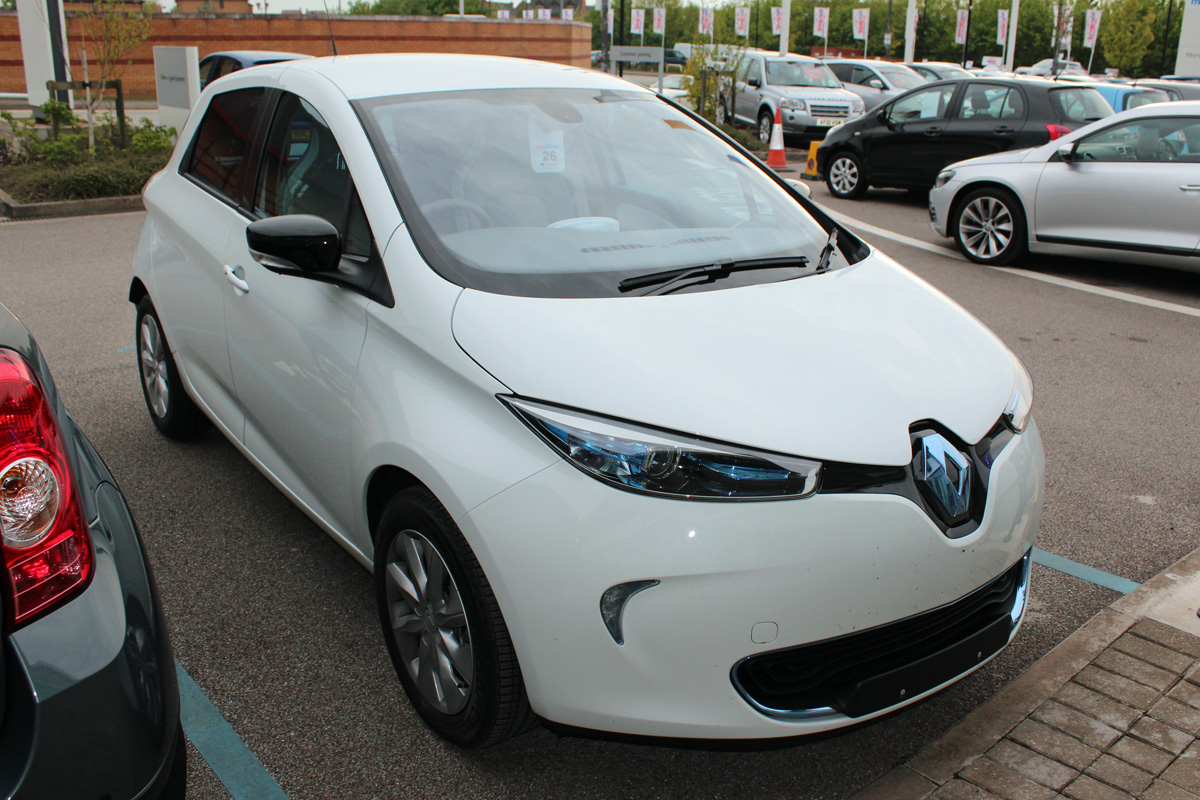
Leaving the dealership and starting on the test drive I found the ZOE very straightforward to drive and I had to agree with my colleagues’ comments – on the whole it is very much like driving a conventional car. In fact, given the wide range of performance and behaviour of cars, it is fair to say that the ZOE sits comfortably within that range and doesn’t stand out in terms of handling, acceleration, steering, braking, etc. for being electric.
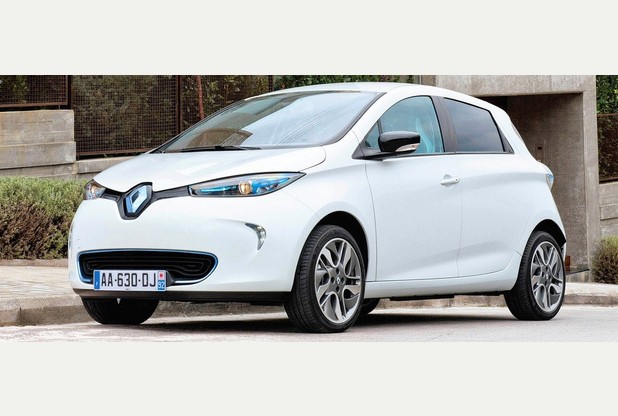
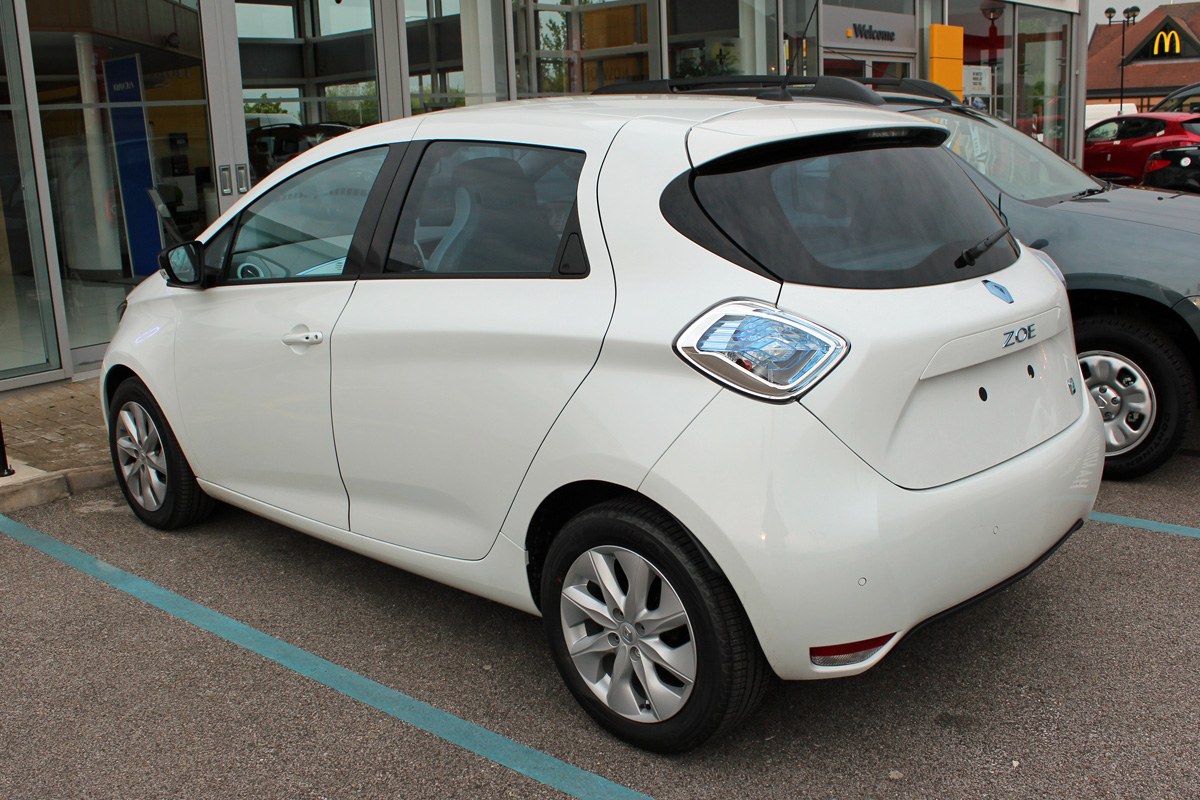
ZOE Zen demonstrator (Image: T. Larkum)
I initially found the acceleration acceptable but not remarkable. However I realised fairly quickly that the ZOE was in ‘Eco’ mode (there’s an indicator at the bottom of the driver’s display) and switched this off (the button is to the left of the gear lever). After that I found the acceleration to be satisfyingly lively at low speeds and still perfectly acceptable at higher speeds.
The ride is good but erring towards firm – the ZOE certainly doesn’t glide over potholes or broken road surfaces (of which there seem to be a lot on British roads at the moment) but nor is it excessively jolting. Overall it gave me the impression of having suspension similar to a ‘hot hatch’ of which I’ve driven a few – a sacrifice of a soft ride to provide good handling. And the handling is good, with the ZOE comfortably managing curving and sharp corners at a range of speeds. Only a couple of times did I have the impression that the car was not responding quite as fast to steering inputs as I expected – the feeling that it was ‘heavier than it looks’. That is a largely unavoidable consequence of carrying a heavy battery pack, only partially compensated for by carrying it low and largely under the centre of the vehicle.
As touched on previously the ZOE is not silent at highway speeds – in fact it almost seemed quite noisy even in the absence of the combustion engine, though of course it’s likely that without engine noise all other noises become relatively more obvious. As well as the road noise there is also noticeable sound from the electric motor. It is much less than that of an engine but it is there. Most of the time it is just a background whirr, but under hard acceleration it produces a distinctive whine which can’t be ignored though – one could argue – it does give back to the driver some of the visceral feedback that you get from a hard-revving petrol engine. Most of the time, though, the motor just produces a background noise that is much less invasive than a combustion engine.
At one point while driving through a pedestrianised area I became aware of another sound that I couldn’t place – a bit like a low frequency rumble as though we were passing a busy factory. The salesman pointed it out as being the ZE Voice becoming activated at our slow speed. I wound down the window to listen to it. I can’t comment on its effectiveness at warning pedestrians of our approach, but as a driver I didn’t like it. I can see me turning it off, or at least choosing my own ‘ringtone’ for it (assuming I can do that) – something like a futuristic Stars Wars-style spaceship sound perhaps. Or just a music track, if that’s possible, such as Ride of the Valkyries.