– where Range is in km and Speed in km/hr, and Speed is from 30km/hr to 140km/hr
I found the data provided by Nosig in Maximising Range in a ZOE very interesting, particularly with regard to how ZOE range is affected by speed. Having done some line fitting on it I believe I have discovered a useful method of predicting the maximum range achievable for a given speed for the ZOE.
To a good approximation it can be summarised by the equation above. In other words, to work out the approximate maximum range at a particular speed you just divide the speed into 1000 and square the result!
This ‘ZOE Range Rule’ is actually simple enough to do in your head while driving along (at least roughly) so you can choose an appropriate speed if required to get to a particular destination – here are some examples:
Range at 125km/hr (78mph) = (1000/125)^2 = 8*8 = 64km (40 miles)
Range at 100km/hr (62mph) = (1000/100)^2 = 10*10 = 100km (62 miles)
Range at 50km/hr (31mph) = (1000/50)^2 = 20*20 = 400km (250 miles)
The second one is particularly easy to remember – the ZOE can travel about 100km at 100km/hr. That’s not an impressive range – but drop the speed and the range can go up hugely.
Of course, these predicted ranges are all approximate and represent the best achievable range (i.e. travelling at constant speed on level ground). With further experimentation and data gathering it should be possible, firstly, to validate and refine the approximate rule above and, secondly, to make a more general model to calculate range taking into account more key variables (e.g. type of route, altitude changes, number of passengers, etc.).
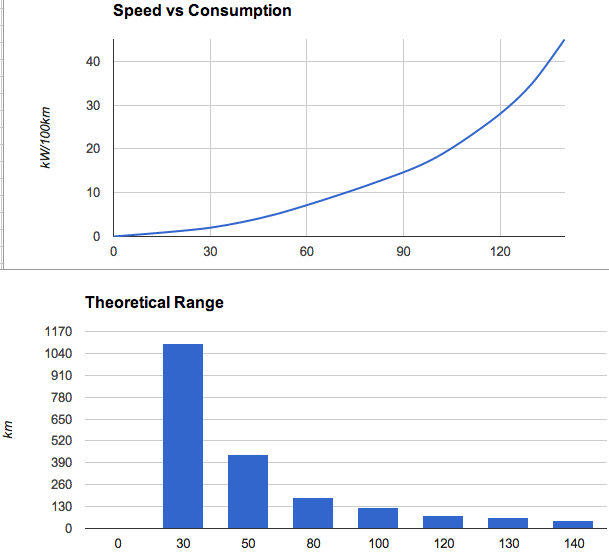
Figure 1: ZOE energy consumption and range at different speeds (Image: Nosig)
When looking to maximise range in an EV, slow speeds are very good since air drag is very low. It increases exponentially with speed. Accelerating harder is not good for efficiency, you trade energy for time. Regenerative braking is never going to be perfect, but the regen on the Zoe can actually charge up to quick-charger speed. If you want max efficiency, let it roll out as much as you can as long as possible. That will enable fewer miles driving under power while regenerating on those same miles.
For the best range ride smooth: accelerate slow and smooth, drive slowly, try to get maximum regen time (so a loooong roll out) if you know you have to slow down, and try to avoid stop and go since the acceleration (and slight loss on decel) will take extra energy. Still it might be better to have a slower route with traffic (bit stop and go), than having a smooth cruise at higher speed, since air drag will be the real killer. Smooth and slow are the keywords for max range.
I have made two graphs with some consumption numbers on the same road with identical circumstances. The absolute numbers are not that important (they change with slope, temperature and wind), but it’s just to show the huge relative influence of speed (thus drag) on consumption and therefore range (in km and km/h). Theoretically, if you constantly drive at bicycle speed, you should be able to drive from the UK to the Côte d’Azur on one charge (see Figure 1).
The assumption here is that the road is constant, level, speed is constant, nothing changes and the indication is more or less accurate. I also assume the full 22 kW is used for range. In this case the air-conditioning was on, but I hardly see any difference in consumption with the airco off. I actually noticed a constant 1 kW/100km consumption at 30 km/h, which would give a theoretical range of 2200 km, but that would distort the graph too much so I changed it to 2 kW/100km.
The thing to learn is the constant exponential increase in consumption, so best speed is the slowest and the increase in range can then be huge (2200 km in theory) as can the penalty with higher speed. A constant 140 km/h would drain the battery completely in about 50 km / 30 miles (!).
A gasoline/petrol car might be able to have a range between 700 and 900 km depending on riding style and circumstances, the Zoe can in theory have a range between 50 and 2000 km. It just indicates that it’s extremely hard to compare range figures with gas cars – it’s a whole different game.
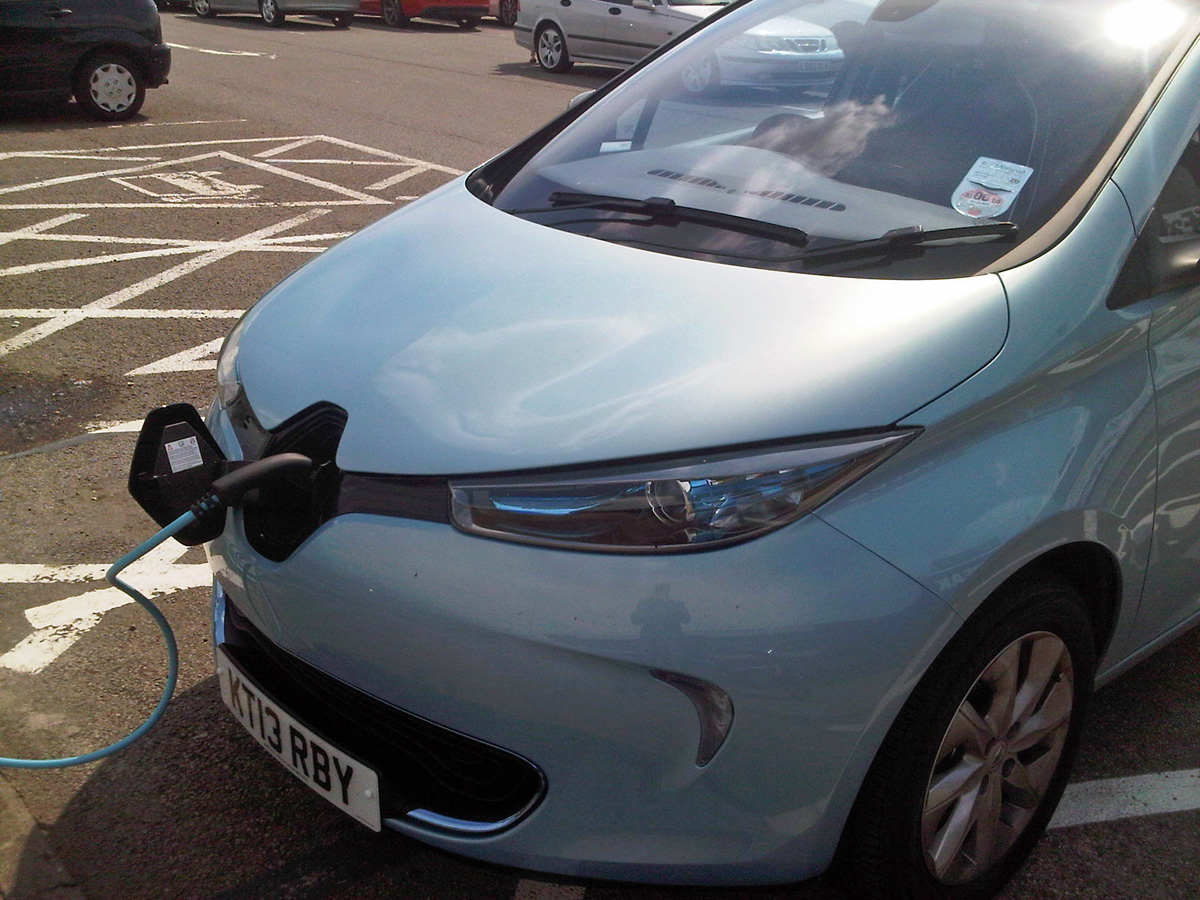
ZOE charging at Leicester 22kW medium-fast charger (Image: A.K.)
Following the first day with our ZOE, including our excellent adventure and bogus journey (with apologies to Bill & Ted), its range capabilities weren’t stretched further as it took up its primary role of commuter (40 miles per day) and around-town transport.
However, just over a week later, I needed to fly abroad on business. Normally I would go from Luton airport which, at about 40 miles from home, could be achieved on a single charge for the roundtrip. Unfortunately the travel was arranged at short notice and the only flights available were from East Midlands airport. Not only is that 60 miles from home (virtually straight up the M1 motorway), but I needed to go via Milton Keynes to pick up a colleague so the total trip would be about 85 miles. Although that is within the range of a single charge there are no fast chargers near the airport so there would be no way to recharge for the return journey.
I therefore decided that I needed to make use of the new Ecotricity fast chargers at the Leicester Forest East motorway services. That gave a fairly comfortable range required of 70 miles. To allow enough contingency to get into Leicester to look for other chargers if the fast chargers weren’t working, I needed a total available range of 80-100 miles.
I therefore set off on the journey with the aim of maximising range. I reset the trip computer on leaving so I could monitor instant and average power usage, and drove entirely in the ZOE’s Eco mode (which limits acceleration, air conditioning power, etc.). I drove carefully – with gentle acceleration and braking – and once on the motorway also limited the speed to about 55mph. The strategies worked and – to keep a long story short – we arrived at Leicester services with plenty of range in hand. The odometer indicated a distance travelled of 64.5 miles, with a range remaining of 35 miles, so ZOE was promising a whisker short of 100 miles of range. In fact, I was tempted to drive around the car park a few times in the hope that the total range indicated would go over the magic 100 miles!
Arriving at the services we looked around for the chargers and found them close to the main building entrance, much like at Newport Pagnell. We plugged into the big fast (43kW) charger and it seemed initially that it was working fine but then I spotted on the dashboard that the charge time was over two hours, when it should have been about half an hour. I tried again with the same result so I didn’t try a third time (given my experience at Newport Pagnell) and instead immediately moved the car over and plugged into the medium (22kW) charger. As at Newport Pagnell that worked perfectly the first time. I reported the problem with the fast charger and we went and had a drink. When we returned about 40 minutes later the car was charged and ready to go.
The trip to the airport was uneventful and we had no trouble parking. I was worried the car park would use valet parking – how does that work if the driver has never encountered an electric car before? – but fortunately it didn’t.
The next day we flew back in, late in the evening. Having been able to charge at Leicester on the way up – even though not at maximum speed – the decision to return there on the way back was easy. Fortunately this time, on the south side, the fast charger worked fine (and the car charge level was still quite high anyway) so we were on our way again after another quick drink.
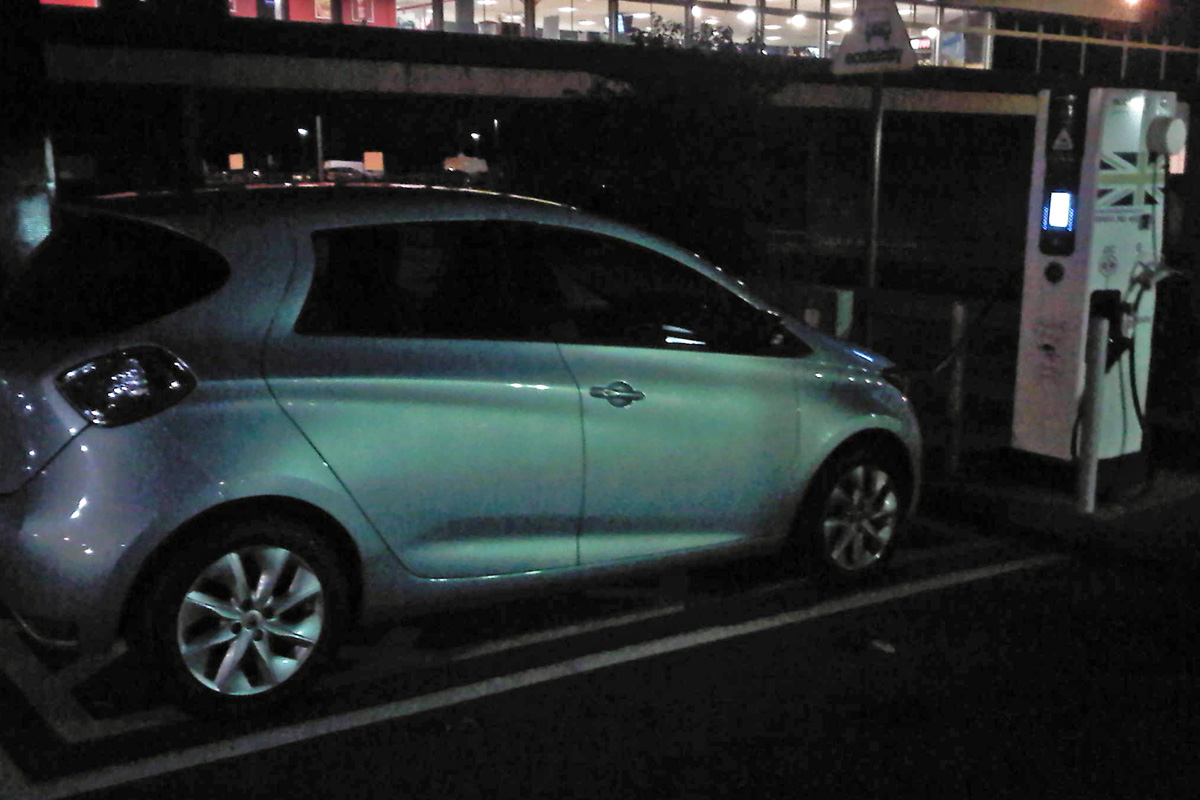
ZOE charging at Leicester 43kW fast charger (Image: A.K.)
The rest of the journey went fine, with range not being an issue and, anyway, a guaranteed charge was available at home. In fact, approaching each charge location I had relaxed and given up on speed restrictions – driving 70mph+ on the motorway – and there had been no problems with range.
This was still just a week after getting the car so I’m very confident that 100+ mile range is comfortably achievable with the ZOE, though it is increasingly clear that with an EV the range capability is almost entirely dependent on driver behaviour.
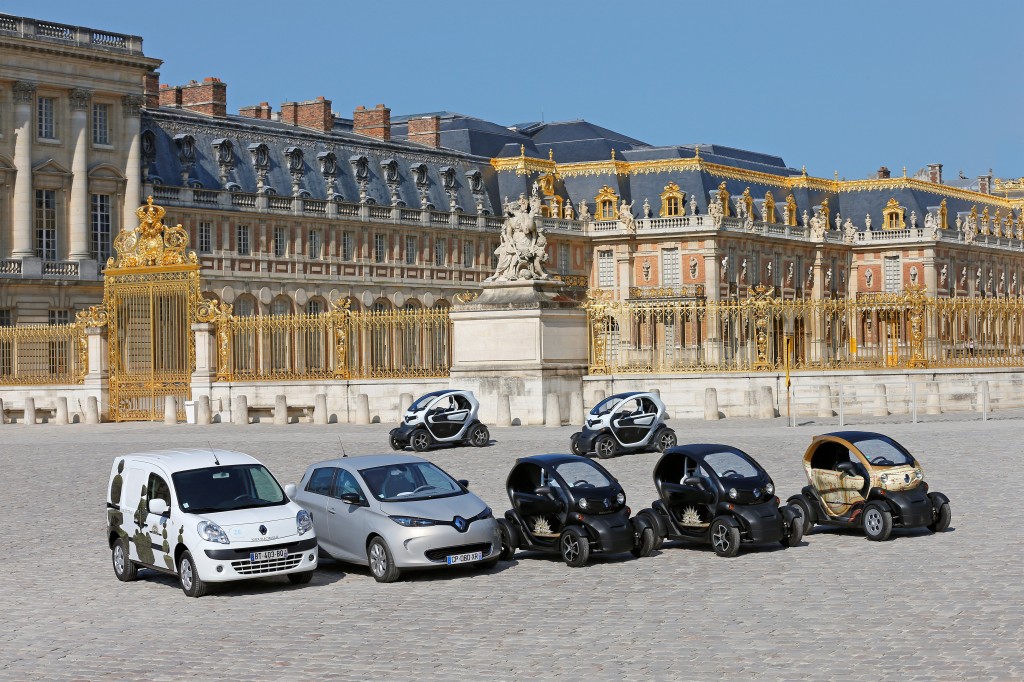
Renault makes a silent arrival at the château de Versailles (Image: Renault Group)
In the XVIIth century, carriages were the only vehicles on the avenues of the Château de Versailles… In 2013, as we celebrate the 400th anniversary of the birth of André Le Nôtre, the gardens he designed have become havens of calm once again thanks to Renault’s electric vehicles. A partnership combining an environmental focus with the comfort and safety of visitors.
To mark the 400th anniversary of the birth of André Le Nôtre, the King’s gardener, the château de Versailles wished to restate its concern for the environment and its commitment to sustainable development. One solution came naturally to mind when looking for a mobility solution that could be used for the monitoring of the 43km of gardens, the upkeep of the 350,000 trees in the grounds, and the planting of 300,000 flowers: only all-electric vehicles could ensure the absence of nuisance in the gardens while respecting visitors.
Renault is the only manufacturer to market a range of all-electric vehicles, from a quadricycle to an LCV, a saloon and city car. For this reason, Renault and the château de Versailles have decided to develop a partnership that will protect the environment of the gardens and safeguard the comfort and safety of 12 million annual visitors.
Twenty-three zero-emission (Z.E.) vehicles will meet the many and varied needs of the domain of Versailles. Three ZOE vehicles are used by service staff to get around the grounds or travel between the national domain of Versailles and Marly; ten Kangoo Z.E. vans, maxi glazed or extended cab versions, are used by the gardeners and curators to carry rare objects, statues, plants and tooling, while ten Twizy quadricycles are used by security staff who appreciate their agile performance in accessing narrow alleyways or when immediate action is required.
Around thirty charging stations have been installed around the national domain of Versailles, as part of a careful layout that respects the architectural integrity of the chateau and grounds, i.e. under the lower windows of the Grande Ecurie stables, in the Trianon domain, at Marly and in the Orangery gardens.
As a nod to history: curious visitors will be able to see a Twizy that is a little bit special: the “Twizy carriage” featuring the decoration found on the carriage owned by the Dauphin or heir to the throne, the future Louis XVII.
RENAULT UK WELCOMES THE ADDITIONAL GOVERNMENT FUNDING FOR ELECTRIC VEHICLE CHARGE POINTS
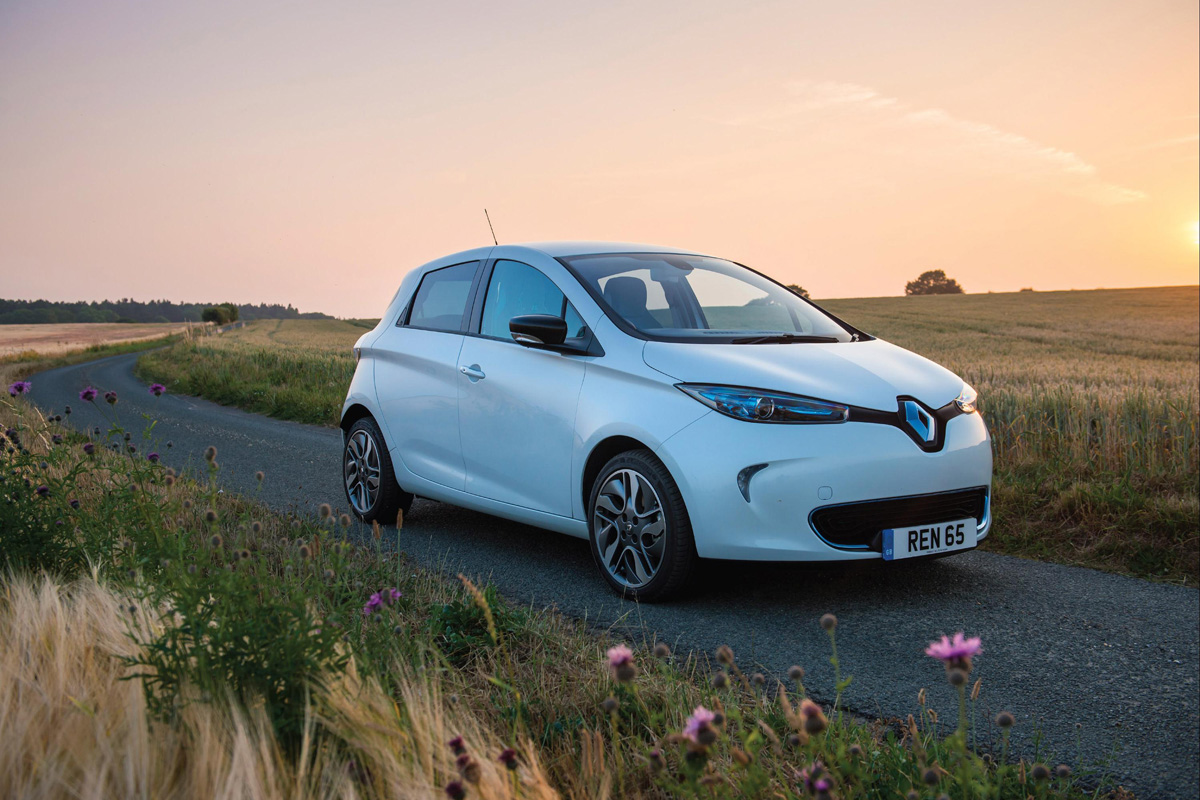
ZOE (Image: Renault)
Renault UK welcomes the additional government funding for electric vehicle charge points with the announcement of the winning bids for additional points to be installed by dozens of local authorities, NHS Trusts and train operators.
Renault’s latest electric vehicle, the ZOE supermini, has just gone on sale in the UK with its owners already enjoying the benefit of a free domestic charge point, supplied and installed by British Gas.
Purchasers also save up to £5,000 on the price of their electric car from the government’s Plug-In Grant. ZOE answers the comment that EVs can be expensive with a starting price from just £13,995, after the grant, equivalent to the price of a diesel supermini, and becomes yet another incentive to make the switch to electric and ‘Drive the change’.
Whilst Renault believes that around 90% of charging will take place at home, Renault’s electric vehicle customers will also benefit from the additional peace of mind that the improved public infrastructure provides.
Commenting on its latest initiative, Renault UK’s Ben Fletcher, Electric Vehicle Product Manager, said,
“The two most common preconceptions of electric vehicles are an expensive purchase price and lack of public opportunity to charge. ZOE’s pricing puts the first point to rest, and this latest announcement, on top of the established highly developed network of public charging points, answers the second and allows customers to buy EV with complete confidence”
Renault is the only manufacturer today with a range of four electric vehicles on sale and, together with its Alliance partner Nissan, has already sold 100,000 EVs across the globe. ZOE, spearheads Renault’s four-strong Z.E. range of 100 per cent electric vehicles and is stylish, affordable and practical – perfect for households whether they’re commuting, doing supermarket and school runs, or even doing moderate distances. ZOE’s official NEDC range is 130 miles, the longest of any EV, with a real-world range of around 90 miles in temperate conditions or 60 in cold weather.
Your one stop source for news and updates on the Renault ZOE. For the latest prices and deals with free charging visit FuelIncluded.com.