INTERNATIONAL Z.E. ROLLOUT – Episode 1: Turning the “sunlight” on ZOE, Twizy and Kangoo Z.E. in Reunion

Turning the “sunlight” on ZOE, Twizy and Kangoo Z.E. in Reunion (Image: Renault)

Renault’s electric vehicles are currently available in 18 countries and continue to be launched in markets around the world. The rollout process will now be accompanied by a monthly saga article. The first focuses on the island of Reunion, where ZOE, Twizy and Kangoo Z.E. recently arrived in Renault dealerships. Local conditions in the new market led to the development of solar panel-powered charging stations, an innovative solution that means Renault electric vehicles here can run and charge in zero-emission mode.

GBH, Renault’s importer and distributor in Reunion, started selling Twizy, ZOE and Kangoo Z.E. on November 11, 2013 through long-term, five-year leasing contracts priced, respectively, at €299, €599 and €499 a month, VAT included.

2014 objective: a charging station every 15 kilometers

Reunion is ideally suited to the introduction of electric vehicles owing to its compact size, facilitating the link-up of charging stations, and the population’s average daily driving distance of just 24 kilometers.

Because public-access charging stations were vital to the launch of the three models, Renault worked upstream on the introduction of the infrastructure. Implementing a comprehensive charging network is easier here than in Metropolitan France as the stations are concentrated on the coast. Today, 19 charging stations are up and running, with the first users “filling up” their vehicles free of charge. The network is to be expanded to 27 stations by the end of 2013, with an objective of one station every 15 kilometers in 2014.

Zero-emission charging stations

In parallel with this charging network, Renault has joined forces with Sunzil to introduce private charging stations going under the name of “Autozil”. Autozil stations are equipped with solar canopies and roofs equipped with photovoltaic panels and an electricity storage system enabling the daily charge of electric vehicles, so motorists can charge their ZOE, Twizy or Kangoo Z.E. with “green” electricity independently of the network operated by the EDF utility.

Sainte Annne charging station (Image: Renault)

The development of the innovative Autozil charging stations was motivated by a local constraint, namely that part of Reunion’s electricity is generated by CO2-emitting thermal power stations, which diminish the environmental benefit of electric vehicles. As an island, Reunion has very few connections with the continental electricity network. Also, the electricity supply-and-demand balance is more fragile here than on the continent. If all electric motorists were to charge their cars in the evening, during peak demand period, the fragility of the electricity network could be exacerbated, leading to power outages.

The situation required an “autonomous” charging infrastructure independent of the local electricity network. And Reunion has harnessed all its expertise in photovoltaic technology to meet that need.

Reunion’s photovoltaic expertise

With an average 52 peak watts of photovoltaic electricity per inhabitant (compared with the French average of 1.6 peak watts), Reunion has considerable solar resources and top-level expertise in photovoltaic panels. The photovoltaic sector on the island comprises some 70 companies for a total 500 megawatts.

VERT tests the electric vehicle ecosystem in Reunion

The VERT project (short for “Véhicule Electrique pour une Réunion Technologique”, or “Electric vehicles for a technological Reunion”), backed by seven public and private partners (Renault, Sunzil, Schneider Electric, EDF, Bernard Hayot Group and Total), was launched in 2010 to test the use of electric vehicles charged using CO2-virtuous solar-powered stations. The project, supported by ADEME*, originated as part of a government initiative to proactively promote electric mobility in Reunion, notably through the “Réussir Innovation” (“Succeeding in innovation”) program in the Grenelle environmental plan for Reunion.

VERT has laid the groundwork for the successful launch of electric vehicles in Reunion and comprehensively trialled vehicle charging using photovoltaic generators not connected to the electricity network.

The arrival of Renault electric vehicles in the island of Reunion is a first step in French overseas departments. In 2014, they’ll be on sale in French Guyana and French West Indies.

* ADEME: French environment and energy management agency on low-carbon vehicles

Renault ZOE to demo usability of EVs in cross European trip

Renault ZOE

A trip to demonstrate the capabilities of electric cars and the availability of the infrastructure to support them, will take one Renault ZOE some 854 miles from Munich to Barcelona.

The new eTourEurope preview trip will see EV fan Werner Hillebrand-Hansen take his car across five countries, arriving in Spain in time for the EV27 fair in the Catalonian capital. Starting in Inning am Ammersee, near Munich, Werner will take his electric car onto to Austria, before crossing through Switzerland and continuing across the south of France before driving over the Pyrenees to Spain.

For rest of story: TheGreenCarWebsite.co.uk.

Renault ZOE in Snow Socks

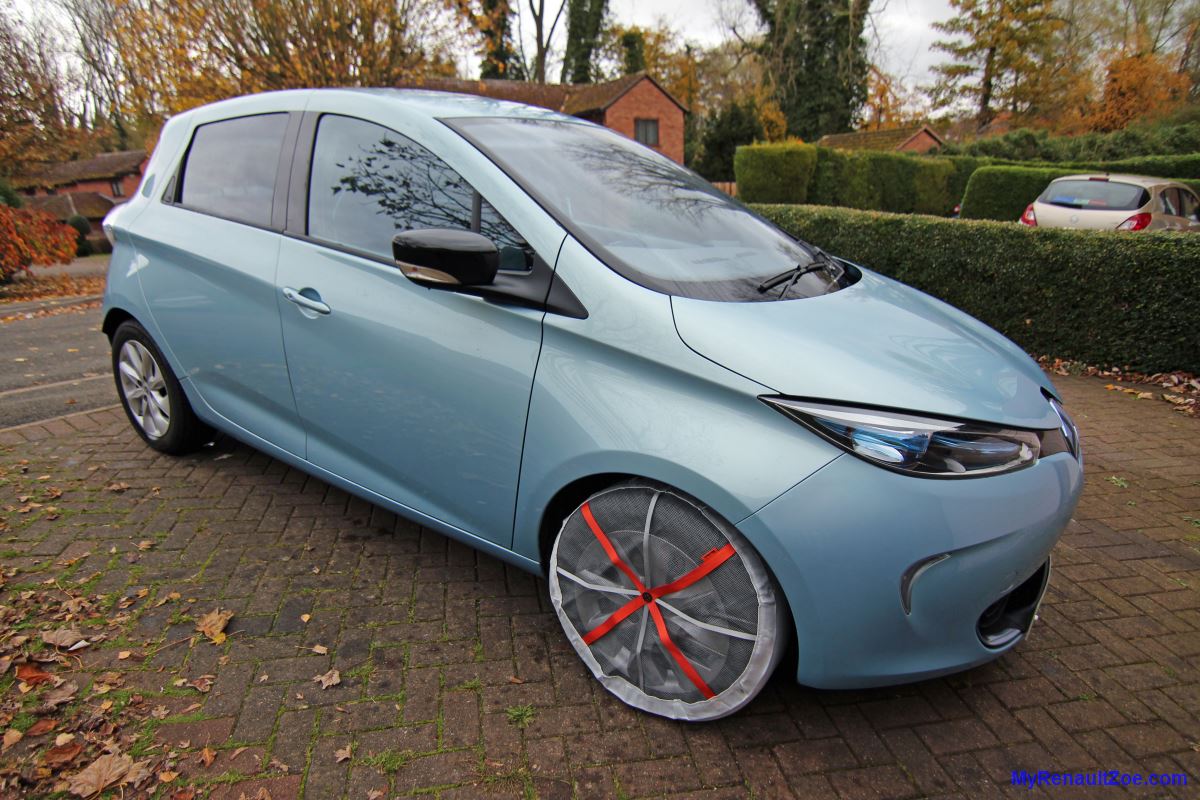
ZOE with AutoSock snow sock (Image: T. Larkum)

Like many British people, the first snow in winter tends to take me by surprise. This year I decided things would be different, and I would prepare in advance. This is partly because it will be my first winter with the ZOE and I’m not sure how well it will behave in snow.

My concerns are twofold. Firstly it is fitted with special EV tyres; these have ‘low rolling resistance’, which as I see it is another way of saying they don’t grip very well. Secondly, EVs do not have the low gearing available to a manual combustion car; driving in snow is a case where the EV feature of high torque available at low speeds is not an advantage.

We live in a short side road that is on a steep hill and so it is very difficult to get out of our road when there’s snow on the ground. However, once out of our road I usually find the roads cleared well enough for me to get to work, except perhaps for the last few hundred yards to the office.

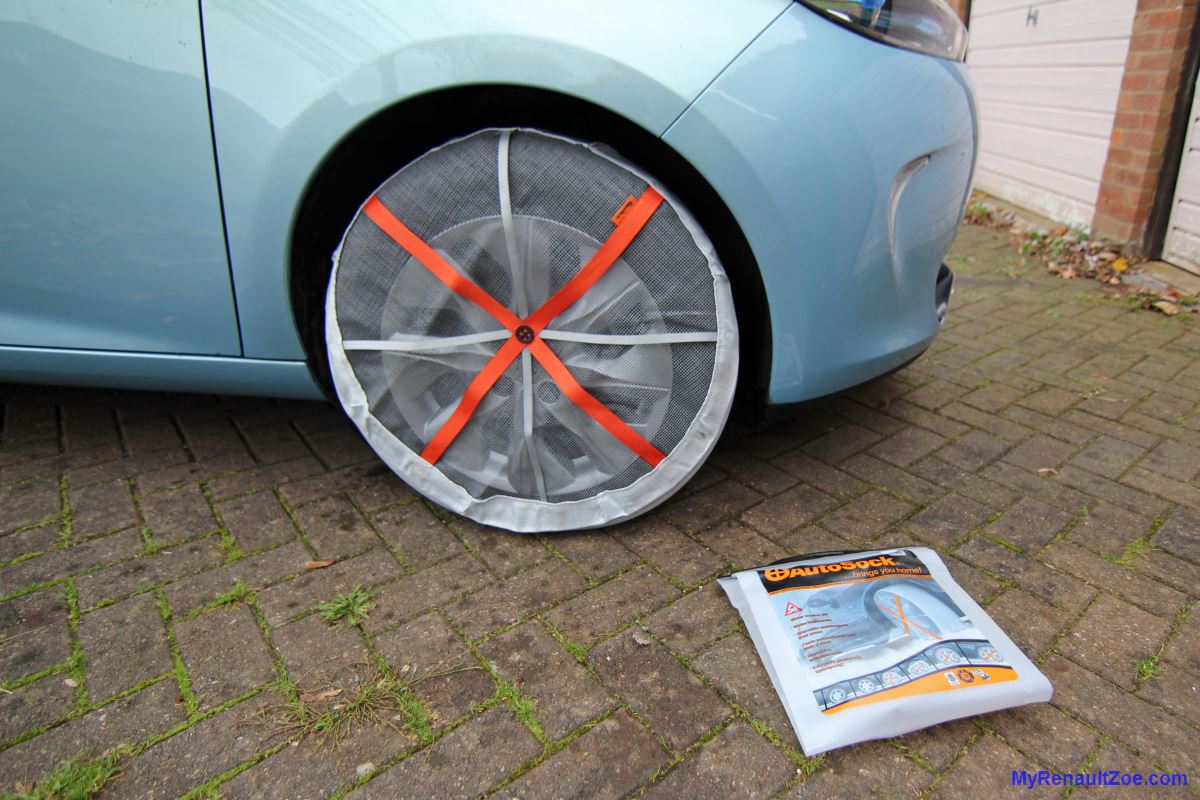
I considered buying snow tyres but I didn’t want to have to store them the rest of the year, and I know that they would reduce range while fitted. I therefore compromised and recently bought a set of snow socks. For those not familiar with the idea, they are a relatively new Scandinavian invention consisting of Kevlar, fabric and mesh covers that fit over standard car tyres to give additional grip.

I tried mine out today, going through the complete process of fitting one to see what was involved. Essentially you pull it over and around the tyre except for the part that is in contact with the ground, then you move the car forward to complete the fitting. They naturally don’t fit entirely symmetrically, but apparently this is corrected automatically once you start driving. I didn’t test this, though, as there are clear instructions that they shouldn’t be driven far on tarmac. I have read that they can wear out completely in 10-20 miles on tarmac, but can last indefinitely if only used on snow.

The snow sock should centralise when driven (Image: T. Larkum)

The socks were a very tight fit – which I guess is a good thing in terms of grip. However, it did mean that they were harder to fit than I expected. In particular there is not a lot of room between the wheel arches and the wheels (the 16” alloys in my case) so it would be more difficult if you had large hands. Also, I suspect it may rule out using gloves which is not a nice thought in snowy conditions.

Based on my experience today I plan to allow up to half an hour to fit both socks, drive carefully out of the road, remove them again and pack them away. In fact, I have added a large bin bag to the equipment in my boot so I can bundle them into it when covered in messy snow.

Anyway, given that I was able to fit one today without incident, I feel pretty confident that I will be able to get them on and off in snowy conditions when I need to, and that they will make a great difference in driving ability. In particular, I’m sure they will enable me to get out of my steep road which is the main requirement – at that point I will remove them before continuing to work. I will also then have the option of fitting them at the other end if I need to.

Having researched various snow socks and suppliers on the Internet I decided to choose AutoSocks. They are, as I understand it, the original patent holders and certainly they have accreditation from various safety and motoring organisations to back it up. There are certainly cheaper suppliers but I suspect they take short cuts, for example skimping on the Kevlar.

AutoSocks can be found on Amazon, and the links are below. Of course other suppliers are available (those are affiliate links) – just Google ‘AutoSocks’ for other sources.

Anyway, I’ll post my experiences of how I get on if/when I get to use these snow socks. If you have used snow socks, snow chains or winter tyres on a ZOE then please add your experiences in the comments.

Of course, I’ll be hugely disappointed if there’s not lots of snow this winter!

Update:

Here’s a useful link for more information: AutoSock FAQ

and a Which video review:

Formula E car completes successful test debut

Fully-electric Spark-Renault SRT_01E breaks cover at La Ferte Gaucher circuit (Image: Renault)

LA FERTÉ GAUCHER, FRANCE, (21 November, 2013) – Formula E’s new fully-electric race car, the Spark-Renault SRT_01E, completed is successful test debut recently at the La Ferté Gaucher circuit near Choisy-le-Roi, France.

Unveiled earlier this year (September) at the Frankfurt Motor Show, the new single-seater was driven by Lucas di Grassi who will be undertaking the early test and development work. The zero emission car completed around 40 laps over two days with the initial task of checking all systems were functioning correctly. For the test, the car was fitted with a 50kw battery which is a quarter of the maximum 200kw power (270bhp equivalent) the final car will produce.

“It is a great feeling to be driving the Formula E car for the first time,” said Di Grassi. “I can assure all the drivers will have a lot of fun with this car – even with just a quarter of the power it has quite a lot of grip and the electric motor produces huge torque.”

The SRT_01E has been designed and built by French based Spark Racing Technology together with a consortium of the leading manufacturers in motorsport, and will compete in the inaugural FIA Formula E Championship – the world’s first global electric race series beginning in September 2014. The chassis has been constructed by Dallara, with McLaren Electronics Systems providing the electric motor, gearbox and electronics, Williams Advanced Engineering the batteries, Renault the overall systems integration and Michelin the tyres.

Frédéric Vasseur, President of Spark Racing Technology, said:

“Everything went very well and it was a very positive maiden run for the Spark-Renault SRT_01E. The car ran for around 40 laps with no issues straight out of the box, which looks good for the overall reliability. We were also running with a much smaller battery than we will use – just 25% of the full power – which again gives us confidence going forward. The next test is planned for the coming weeks where we want to increase the mileage on the car, working our way up to a full race simulation.”

Alejandro Agag, CEO of Championship promoters Formula E Holdings, added:

“The first test was a historic moment for the championship and we’re delighted with how it has gone. We think teams, drivers and fans will love the way it looks and sounds. Now Frédéric and his team, together with Lucas, will begin to put mileage on the car, focusing on durability. It’s a very exciting development and we can’t wait for that first race in Beijing in September 2014 to see all 20 cars lined-up on the grid.”

RSPB spreads its electric wings with new Renault ZOE

RSPB spreads its electric wings with new Renault ZOE: Ben Fletcher, Electric Vehicle Product Manager, Renault UK and David Waller, Head of Central Services, RSPB (Image: Renault)

Renault’s multi-award-winning electric supermini ZOE is now flying even higher after being adopted at the RSPB’s headquarters. The French brand’s flagship plug-in has recently been paired with the charity’s other electric Renault, a Kangoo Van Z.E, at its Bedfordshire base near Sandy, to help reduce its carbon footprint even further.

The RSPB (Royal Society for the Protection of Birds) believes climate change poses the single biggest threat to the long-term survival of birds and wildlife. As such, it recently submitted a planning application for a single wind turbine on a field adjacent to the headquarters at The Lodge. In the future, energy created on site could be powering the new ZOE and popular Kangoo Van Z.E. renewably.

David Waller, RSPB’s head of central services, said:

“As a wildlife conservation charity acutely aware of the potential impact of climate change, the RSPB is particularly committed to minimising its own CO2 emissions.”

Mr Waller said its 300-vehicle strong fleet operations is an “obvious area” where reductions can be made and the new ZOE Expression in Arctic White, is already having a positive impact.
He added,

“The operational success of the two electric Kangoo Vans, one being in London, definitely influenced our thinking when considering the ZOE. As a charity with limited funds, the price point was another positive factor in our decision.

“Clearly, we have to ensure the vehicle is utilised realistically and within its range capabilities, but they are sufficient to cover many of the business journeys made by staff. So far the ZOE has proved very popular with drivers.”

The trailblazing Renault ZOE arrived on the scene in June this year to much industry and media acclaim. The flagship of the French brand’s four-strong 100 per cent electric vehicle range is stylish, affordable and incredibly versatile – perfect for commuting and for businesses who want to downsize their engines and carbon footprint.

It boasts a series of world firsts, including the aptly named Chameleon charger, which can adapt to all power levels from 3kW up to 43kW.

Charging batteries up to 80% at a charging station can take from as little as 30 minutes, using a Rapid Charger 43kW AC power source.

ZOE is the first affordable car for everyday use designed from the ground up as an electric vehicle, with the longest range of any pure electric vehicle this side of a £50,000 Tesla. Its official range is 130 miles (New European Drive Cycle) with a real range of between 90 miles in temperate conditions and 64 in cold.

It starts from £13,995 (after the UK Plug-In Car Grant), comparable to a diesel-engined supermini alternative, with the added bonus of a free domestic 7kW Wall-box, supplied and installed by its preferred electric vehicle charging partner, British Gas, plus a national network card giving access to a UK network of hundreds of charging points until 31st March 2014. Battery hire costs from £70 per month and as part of the contract comes a battery performance guarantee which commits to a minimum 75% of its original charge capacity, or else it will be repaired or replaced, plus full 24/7 roadside assistance, even if you run out of charge.