

Each year I go to Essen, Germany for a big board game convention. Since I bring home a sizable amount of games, we have opted not to use the train. Hauling back is simply easier with a car.
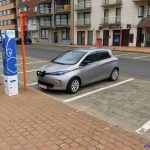
This year is the first time we don’t have an ICE available to make that trip, so we again faced the choice: go by train or use the ZOE. A quick look at the charger map made the decision easy: there’s plenty of AC chargers along the way, most of them 22kW or more.
The trip would take me from the South of Flanders in Belgium through the South of the Netherlands in to the Ruhr region of Germany. A 300km trip, one way.
We already have a The New Motion charging pass which we occasionally use in Belgium, but it also works on a lot of chargers in The Netherlands. After all, The New Motion is a Dutch company. So I felt confident I would be fine with just the one card.

I also had a look at Germany. The last charger I would use in The Netherlands was in Venlo, 65km from my destination. Going from there to Essen and back was certainly possible without recharging, but not at highway speeds. I quickly found out there where 2 AC quick chargers in Duisburg, only 15km from Essen that sould work with my New Motion card.
I also knew an RWE charger at the end of the street my hotel is in, so charging there would be more convenient. I contacted RWE and they told me I could use their chargers using the PlugSurfing service. I went on to the PlugSurfing website to register, and found they had two options: use the app or get a pass for almost €10. They where so nice as to tell me that not all chargers would work with the app yet, so the pass was a safer option. Since I probably wouldn’t have 3G connectivity and the app wasn’t compatible with my older smartphone, I got the pass, which arrived just in time for the trip.
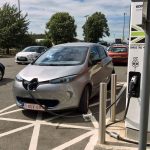
We left from my home and drove to Turnhout, some 126km away. We drove mostly 90km/h on the motorway, and we arrived with about 20km of range left. Since the Turnhout charger is – like most AC chargers in Belgium – only 22kW, we had plenty of time to grab a bite.
We then drove on to Venlo, 101km further, also at 90km/h for most of the time. We had slightly more range left, but this was the last charger on our route that wasn’t in Germany, so I felt it was the last one we could count on. A nice surprise was that this charger was 43kW, even though the website had indicated it was 22kW. But there was also a secondary 22kW charger available. I did notice that even though it is rated at 43kW, it did take slightly longer to charge than it ever did on my trip the the UK, using Ecotricity chargers.
When the battery was at 99%, we went on our way to Essen. We arrived there with about 80km of range left, enough to get back to Venlo if nothing unexpected happened. But I decided to charge in Germany if possible just to make the trip back more comfortable.
After 6 days at the convention it was time to head back. Before breakfast and packing, I went to the RWE charger with my car. Upon arriving there the charger was ICEd, but my cord was long enough to reach it from a nearby spot. But the charger didn’t have an RFID reader, meaning that it could only be activated with the app, the opposite of what the PlugSurfing site had warned for. On the Duisburg then.
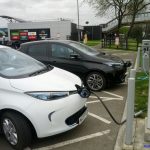
When we arrived in Duisburg we found the charger very easily. A plug-in Volvo was charging on one side with a Schuko plug, but the other side was free and both sides could be activated independently. You can’t plug in unless you unlock the port with your RFID card, so I swiped my The New Motion card, which was the one that was supposed to work. It took very long to authenticate before being rejected. I tried again, but the rejection was clearly cached in the charger, as it was immediately rejected again. I tried the PlugSurfing pass just in case it would work, but I got an error message which I didn’t understand.
I didn’t feel like placing an expensive international phone call to get the thing to work, so we went on to Venlo to charge there. We arrived there with 20km of range left. The rest of the journey went as planned.
I’m glad this happened in a situation where I didn’t really need the charge, but if I ever make a longer trip through Germany, I’ll make sure to do more research and be better prepared because this can hardly be called a success.
Home › Forums › My 600km trip from Belgium to Germany
This topic contains 5 replies, has 3 voices, and was last updated by Alex P. 11 years, 11 months ago.
You must be logged in to reply to this topic.